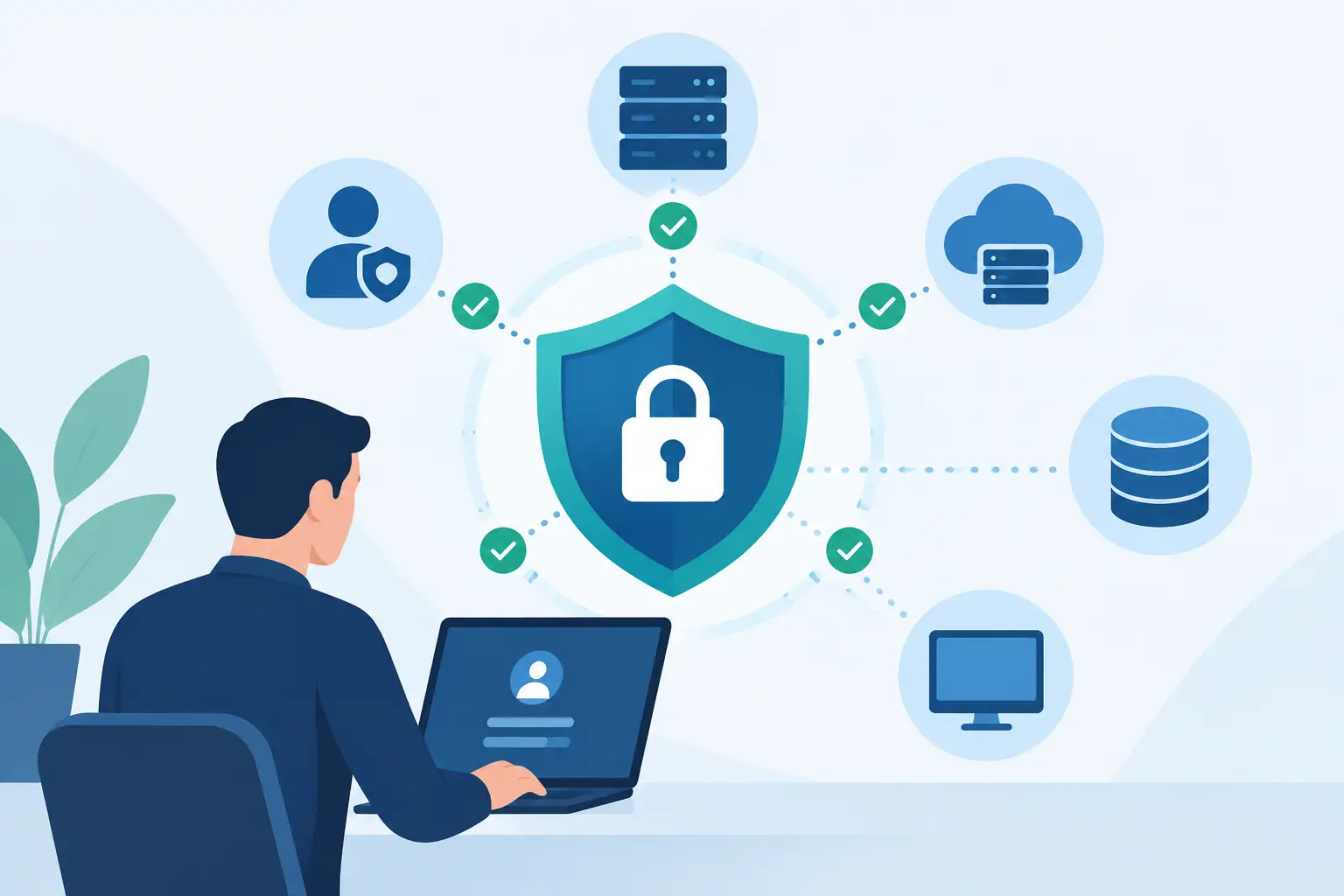
A privileged account can stop a production line, alter financial records, disable defenses, or turn a contained intrusion into an enterprise-wide event. That is why the best privileged access controls are not a vault of static administrator passwords. They are a disciplined system for proving who needs elevated access, limiting what that access can do, watching every privileged action, and cutting off the session the moment risk changes.
For security and operations leaders, this is not merely an identity project. Privileged access is the control plane for the business. When that plane is compromised, attackers can create accounts, change policies, erase evidence, and establish persistence faster than traditional response processes can react. The objective is clear: make privileged access temporary, specific, verified, observable, and recoverable.
What the Best Privileged Access Controls Must Do
A mature program assumes that an administrator credential will eventually be targeted. Phishing, token theft, service-account abuse, exposed secrets, malicious insiders, and vendor compromise can all provide a path to elevated access. The control set must therefore reduce both the likelihood of misuse and the blast radius when misuse occurs.
The strongest programs enforce least privilege through role-based access control and attribute-based access control. Roles establish the baseline of what a database administrator, plant engineer, cloud operator, or help desk analyst may do. Attributes add the context that roles alone cannot provide: the device posture, location, shift, ticket number, data sensitivity, threat score, and target environment. An approved administrator on an unmanaged device at 2:00 a.m. should not receive the same authority as that same administrator on a compliant workstation during an approved maintenance window.
Default deny is the foundation. Access should be granted only when identity, device, context, and intent meet policy. This takes effort to design well, especially in organizations with years of inherited permissions. But broad standing access is operational debt with a breach clause attached.
1. Replace Standing Privilege With Just-in-Time Elevation
Just-in-time, or JIT, elevation is among the most effective controls because it removes the attacker’s favorite condition: persistent administrative authority. A user begins with standard access and requests elevated permissions only for a defined task, target system, and period of time. The privilege expires automatically.
A strong JIT workflow ties elevation to an approved request, change ticket, or defined operational playbook. It can require manager approval for routine actions and security approval for sensitive actions such as modifying identity policy, accessing domain controllers, changing payment workflows, or entering a regulated production environment.
The trade-off is speed. If approval gates are poorly designed, they become a bottleneck and employees find workarounds. Mature implementations distinguish between normal work, emergency work, and pre-approved recurring work. They automate the low-risk path without treating all requests as low risk. The goal is not to make administrators wait. It is to ensure that powerful access exists only long enough to accomplish a legitimate mission.
2. Require Phishing-Resistant Authentication
Passwords, even complex ones, cannot defend privileged access on their own. Privileged users should authenticate with phishing-resistant factors such as WebAuthn or FIDO2 hardware keys, supported by strong identity proofing and device trust. These controls make it substantially harder for an attacker to reuse stolen passwords or relay credentials through a fake sign-in page.
Additional factors such as TOTP or out-of-band verification can support recovery and stepped-up authentication, but they should not become an excuse to retain weak primary authentication. Authentication must also be resistant to session theft. A valid login is not proof that every subsequent request is legitimate.
For high-value environments, cryptographic agility matters. Organizations responsible for long-lived sensitive data, defense programs, industrial systems, or federal workloads should plan for post-quantum cryptography hardened authentication and protected administrative communications. The practical question is not whether every legacy application can be modernized overnight. It is whether the organization has a staged plan to protect its highest-risk access paths first.
3. Control the Privileged Session, Not Just the Login
Many access programs stop at authentication. That leaves a major gap. A legitimate administrator can make a dangerous change after login, and an attacker using a stolen session token can do the same. Privileged session management closes that gap by brokering access to sensitive systems, limiting commands where appropriate, recording activity, and monitoring for abnormal behavior.
Session recording is useful for investigation, but recording alone is not a preventive control. The best design pairs evidence with active enforcement. A policy engine should be able to challenge, restrict, or terminate a session when risk changes. Examples include an administrator attempting to access systems outside an approved scope, bulk-exporting data, disabling security tooling, creating a new privileged identity, or connecting from an untrusted endpoint.
For cloud consoles, infrastructure-as-code pipelines, network devices, and industrial control environments, controls must fit the operational reality. Some OT systems cannot tolerate an agent, frequent reauthentication, or unexpected session interruption. In those cases, use hardened jump hosts, segmented management networks, tightly controlled maintenance windows, and protocol-aware monitoring. Security controls that interrupt safe operations are not controls leaders will sustain.
4. Secure Service Accounts, Secrets, and Machine Identities
Human administrators are only part of the privileged access surface. Service accounts, API keys, certificates, workload identities, and automation tokens often hold persistent authority across critical systems. They are also frequently invisible to traditional reviews because no employee signs in with them.
The right approach starts with a reliable inventory. Identify every machine identity, its owner, purpose, permissions, authentication method, last use, and dependencies. Then eliminate shared secrets where possible. Use short-lived credentials, workload identity federation, scoped tokens, and automated rotation. A secret that lives indefinitely in a script, repository, configuration file, or third-party tool is a standing privileged account by another name.
Ownership is decisive. Every privileged machine identity needs a named business and technical owner. If no one can explain why it exists, what it can access, and how it is rotated, it should not retain authority.
5. Separate Duties and Protect the Control Plane
A single administrator should not be able to request privilege, approve it, modify the policy, and erase the evidence. Separation of duties prevents ordinary mistakes from becoming catastrophic failures and makes insider misuse harder to conceal.
Protect identity infrastructure, PAM policy, endpoint-management platforms, backup systems, security tooling, and cloud tenant administration as crown-jewel control planes. These systems deserve stricter elevation rules, separate administrative accounts, stronger authentication, and more aggressive monitoring than routine business applications. If an attacker controls the identity provider or backup console, recovery becomes far more difficult.
Break-glass access is necessary, but it must be treated as an exception with consequences. Emergency accounts should be isolated, tightly documented, protected with separate strong factors, continuously monitored, and reviewed immediately after use. A break-glass account that is never tested may fail when the enterprise needs it most. One that is routinely used is simply uncontrolled standing privilege.
6. Detect Abuse and Contain It in Minutes
Access governance tells you what should happen. Detection tells you what is happening. The two must work together. Native SIEM analytics, user and entity behavior analytics, endpoint telemetry, network inspection, and identity signals can expose activity that no static access review will catch.
Look for impossible travel, unusual elevation requests, new admin-account creation, privilege changes outside maintenance windows, anomalous remote administration, mass secret retrieval, access to unfamiliar assets, and attempts to disable logging. Detection should be mapped to known attacker techniques so teams can prioritize the behaviors most associated with credential access, lateral movement, defense evasion, and persistence.
Containment must be automated where confidence is high. Revoke an active session, block a hostile source, disable a newly created suspicious identity, isolate a compromised endpoint, or require reauthentication before an attacker can expand access. Every action should produce signed, timestamped evidence that supports incident response and audit review. Speed without evidence creates governance risk. Evidence without speed creates operational risk.
How to Choose Privileged Access Controls That Fit
The right design depends on the systems that keep the organization operating. A cloud-first enterprise may prioritize identity federation, ephemeral roles, CI/CD secrets, and SaaS administration. A manufacturer or utility may place greater weight on jump-host security, vendor access, maintenance controls, and availability-safe containment. A defense contractor or regulated enterprise may need continuous evidence mapped to CMMC, FedRAMP, NIST, IEC 62443, or customer requirements.
Evaluate controls against a simple operational test: Can the organization identify privileged access, verify it continuously, limit it precisely, observe it completely, revoke it quickly, and restore operations if the control plane is attacked? Products that address only password storage or only approval workflows do not meet that standard alone.
Vulcan Rampart applies this inside-out Zero Trust posture to privileged sessions, identities, devices, and data so access decisions can change as conditions change. The measure is not a clean access-review report. It is whether the enterprise can contain compromise, preserve audit evidence, and keep the mission moving when a trusted account becomes the attacker’s entry point.
Privilege should never be a permanent possession. Treat it as a time-bound operational capability that must continuously earn its authority. That discipline gives defenders room to act before a compromised account becomes a business-stopping incident.