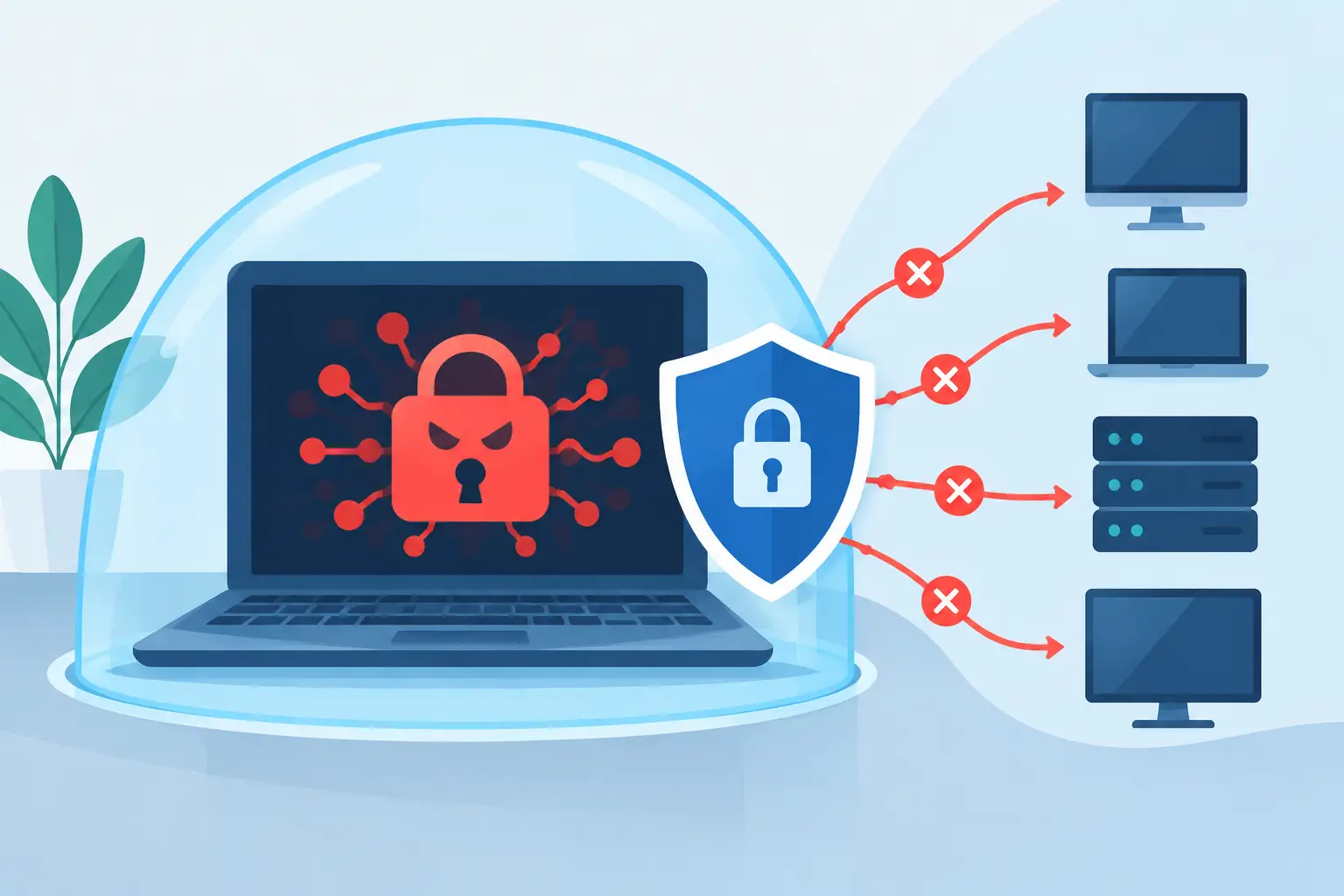
A ransomware event is not contained when the first encrypted endpoint is taken offline. It is contained when the attacker can no longer reach identities, move laterally, trigger encryption, destroy recovery paths, or communicate with systems that matter. For leaders responsible for production, regulated data, operational technology, and privileged access, knowing how to contain ransomware means making decisions in minutes that preserve the ability to operate for weeks.
The first objective is not cleanup. It is to stop propagation without destroying the evidence needed to understand the intrusion, meet reporting obligations, and restore safely. That requires a practiced command structure, accurate visibility, and controls that can enforce a deny-first posture across endpoint, identity, network, and data layers.
How to Contain Ransomware in the First Minutes
Treat the incident as active until evidence proves otherwise. A ransom note is usually a late-stage signal, not the start of the attack. By the time encryption is visible, an adversary may already hold privileged credentials, persistence mechanisms, stolen data, and access to backup infrastructure.
Activate the incident response team immediately. Establish a controlled communications channel that does not rely on the potentially compromised tenant, email platform, or collaboration environment. Assign one incident commander with authority to approve containment actions, and separate the work into three tracks: stopping spread, preserving evidence, and protecting business continuity.
Then isolate affected systems. Network isolation should block lateral movement while maintaining, where possible, the telemetry needed for investigation. Endpoint detection and response tooling can place known or suspected hosts into network containment. At the network layer, deny traffic from affected segments to file shares, domain controllers, backup repositories, remote-management platforms, and administrative interfaces.
Do not assume every affected system needs to be powered off. Shutting down a workstation may halt encryption, but it can also erase volatile evidence and disrupt a critical process. For a standard user endpoint actively encrypting files, isolation is often the right first move. For servers, industrial control environments, medical systems, or safety-sensitive workloads, the containment decision depends on operational impact. Engage operations leadership before taking an action that could create a safety event or extended outage.
Cut Off the Attacker’s Identity Paths
Ransomware operators rarely depend on one infected machine. They move through valid accounts, remote administration tools, stolen session tokens, service identities, and delegated privileges. Containment fails when the endpoint is isolated but the attacker remains authenticated elsewhere.
Revoke active sessions for suspected accounts and force credential resets based on evidence, risk, and account sensitivity. Prioritize privileged users, domain administrators, cloud administrators, backup operators, help desk personnel, and service accounts with broad access. Disable accounts that show impossible travel, unfamiliar device registration, unusual privilege elevation, or high-volume access to shares and data stores.
This is where a Zero Trust model changes the outcome. Access should not survive simply because a user authenticated earlier in the day. Every session, request, device, and packet must be evaluated continuously against identity, device posture, location, behavior, and policy. Just-in-time privilege windows reduce the number of standing administrative credentials an attacker can weaponize. Role-based and attribute-based policies narrow the blast radius when one identity is compromised.
Be deliberate with service accounts. A rushed password reset can interrupt line-of-business applications, automation, and production workloads. Map dependencies first where time permits, then rotate credentials in a controlled sequence. If there is evidence that service accounts were used for lateral movement, the operational inconvenience is secondary to the risk of leaving the attacker’s path intact.
Protect Backups Before Recovery Becomes the Next Target
Ransomware groups know that recoverable backups weaken their leverage. They actively seek backup consoles, storage administrators, replication tools, snapshots, and cloud recovery credentials. Containment must extend to the recovery environment before restoration begins.
Separate backup infrastructure from the affected identity plane and restrict it to a small, verified recovery team. Suspend replication from potentially compromised systems so encrypted or maliciously altered data does not overwrite healthy copies. Confirm the integrity, age, and immutability of backups using clean administrative devices and accounts.
Do not restore into an environment that still trusts the attacker. If persistence remains in identity infrastructure, endpoint management, virtualization tools, or remote access systems, restored assets can be re-encrypted quickly. Recovery should follow containment, eradication, and validation, not run in parallel as an act of optimism.
For mission-critical environments, establish a prioritized recovery order before an incident occurs. Start with identity services, security tooling, core network services, and the applications that sustain revenue, public services, safety, or contractual obligations. The right order varies by organization, but the principle does not: restore the controls that make the rest of the recovery trustworthy.
Preserve Evidence Without Slowing Containment
Containment and forensics are not competing priorities. Strong evidence tells responders which systems were accessed, what data may have been taken, whether the threat actor still has a foothold, and which legal or regulatory notifications may apply.
Capture volatile data from high-value systems when feasible, including active connections, running processes, logged-in users, memory artifacts, scheduled tasks, and remote-access activity. Preserve endpoint alerts, firewall logs, DNS records, identity-provider events, cloud audit logs, and relevant file-access records. Maintain chain-of-custody discipline for every artifact and document every containment action with its time, owner, and reason.
Avoid using compromised administrative workstations to investigate or restore. Build a clean response enclave with known-good devices, tightly controlled accounts, and isolated communications. This prevents responders from becoming another route for attacker access.
Signed, timestamped response evidence matters after the immediate crisis. Boards, insurers, customers, auditors, regulators, and counsel will ask what happened and what the organization did about it. An accurate timeline protects credibility and turns response activity into defensible proof.
Contain Ransomware Across the Whole Attack Surface
A single control cannot hold the line against an enterprise ransomware operation. Endpoint isolation is necessary, but it is not enough if malicious traffic continues across the network, identities remain overprivileged, data is exposed through cloud services, or unmanaged devices retain access.
An effective containment posture coordinates these actions:
- Block known hostile IP addresses, domains, command-and-control patterns, and suspicious outbound connections at DNS, firewall, proxy, and endpoint layers.
- Quarantine suspicious endpoints and prevent them from reaching administrative services, file shares, backup systems, and peer devices.
- Revoke risky sessions, restrict privileged access, and require stronger authentication for recovery personnel and high-value accounts.
- Disable unauthorized remote tools and inspect legitimate remote-management platforms for misuse.
- Apply data-loss prevention controls to detect or stop abnormal transfers, archive creation, and exfiltration from sensitive repositories.
Automation can compress response time, but it needs guardrails. Automatically blocking a confirmed malicious IP is low risk. Automatically disabling a production service account may be justified only when behavior and business impact have been evaluated. The best playbooks automate repeatable actions while escalating decisions that could affect life safety, production continuity, or regulated operations.
Validate Before Declaring the Incident Over
The absence of new ransom notes is not proof of containment. Attackers may wait, retain credentials, or use a second access path after defenders relax. Validate that malicious persistence is gone across endpoints, identity systems, scheduled tasks, cloud applications, remote access, and network devices.
Threat hunting should focus on the techniques used in the intrusion, not only on the ransomware file itself. Search for credential dumping, abnormal authentication, newly created accounts, unusual use of remote-management tools, suspicious PowerShell or scripting activity, changes to group policy, backup deletion attempts, and anomalous data movement. Mapping the investigation to recognized adversary behaviors helps teams find the paths an attacker used before encryption began.
Increase monitoring during restoration. Newly rebuilt or recovered systems should enter a more restrictive access state until they meet security requirements. Validate patches, endpoint protection, device configuration, identity permissions, logging, and network segmentation before returning workloads to normal service.
Build Containment Into the Architecture
Ransomware containment is decided long before an incident bridge opens. Organizations that recover quickly have already segmented critical assets, limited standing privilege, tested recovery, cataloged sensitive data, and rehearsed decisions with IT, security, legal, communications, and operations leaders.
Vulcan Rampart approaches this as a mission-continuity problem: detect in seconds, contain in minutes, resolve with evidence intact. A policy engine that continuously verifies identity and context, paired with SIEM analytics, UEBA, EDR integration, threat hunting, and SOAR containment playbooks, creates the control plane needed to act before one compromised system becomes an enterprise outage.
The strongest closing action is practical: run a ransomware containment exercise against your most critical business service. Measure how long it takes to isolate a host, revoke a privileged session, protect backups, confirm the recovery path, and brief leadership with facts. The gaps revealed in that exercise are the ground an attacker will try to take. Build the bulwark there, before the alarm sounds.