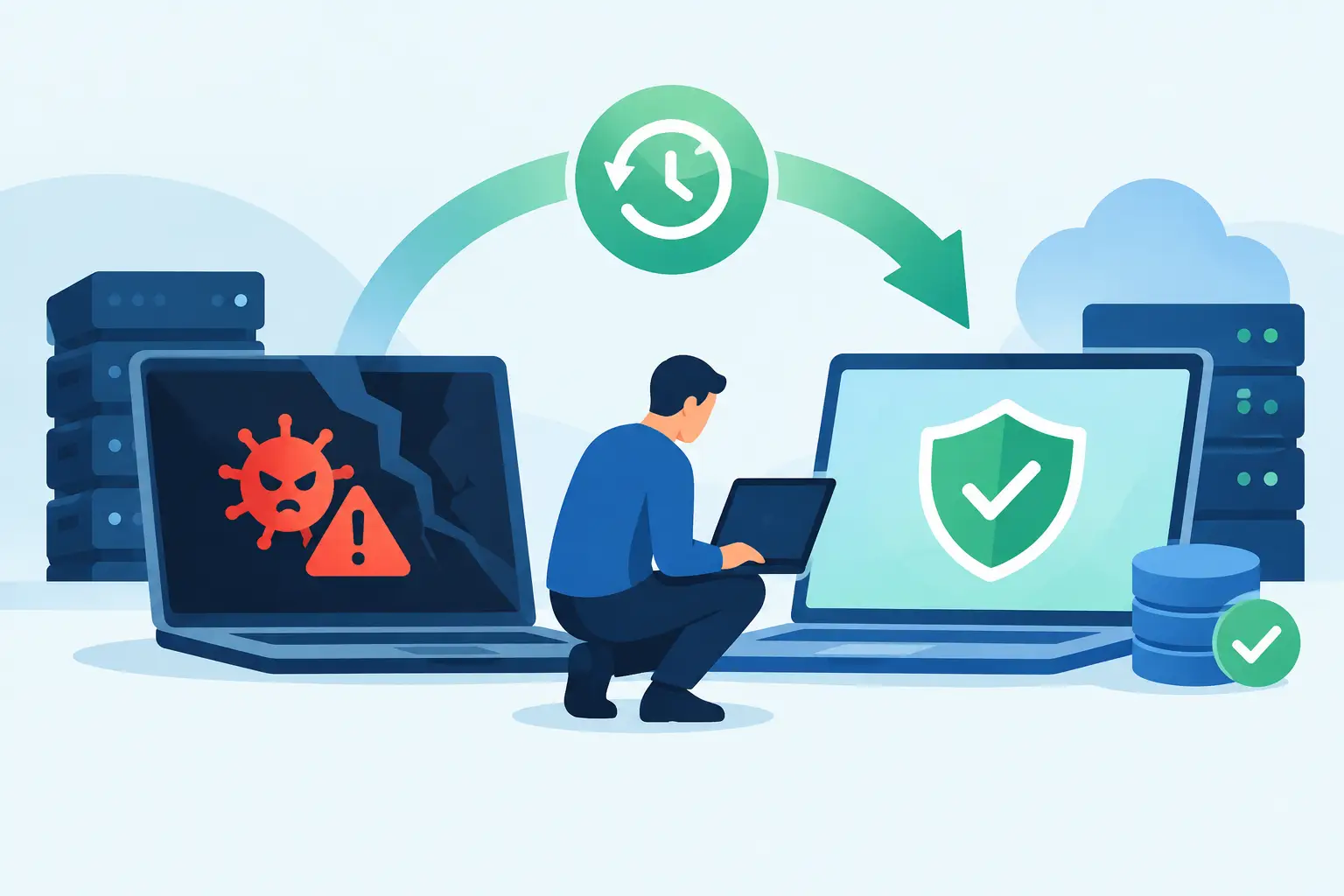
A breached system is not restored when users can log in again. It is restored when the attacker no longer has a path back in, the business can operate safely, and the organization can prove what happened. That is the standard for how to restore breached systems without converting an active incident into a second compromise.
Speed matters, particularly when production, privileged accounts, sensitive data, or operational technology are affected. But speed without discipline can preserve malware, reactivate stolen credentials, erase evidence, and expand the blast radius. The recovery mission is clear: contain the threat, preserve the facts, rebuild trust, and return essential operations in controlled stages.
Start With Containment, Not Restoration
The pressure to bring systems back online can be intense. Revenue is stalled, employees are locked out, customers are waiting, and leadership needs answers. Yet restoring a server before the intrusion is contained may give an attacker a fresh, trusted foothold.
First, isolate affected endpoints, workloads, network segments, and identities. Isolation does not always mean shutting everything down. A critical application may need to remain available while its administrative plane, lateral network paths, remote access, and privileged sessions are restricted. The right action depends on operational impact, the evidence of active compromise, and whether safe segmentation exists.
Containment should include revoking active sessions, disabling or tightly restricting suspicious accounts, blocking known hostile infrastructure, and removing compromised devices from trusted networks. If an attacker has obtained administrative access, assume that the original point of entry is not the only problem. Their objective may be persistence, privilege expansion, data theft, destructive action, or preparation for ransomware.
Every containment action should be recorded with a timestamp, owner, rationale, and technical result. This record supports incident decisions, insurance requirements, legal review, and regulator scrutiny. It also prevents a familiar failure during a high-pressure event: one team re-enables what another team deliberately blocked.
Establish the Real Scope of the Breach
Recovery cannot be based on the first alert alone. The visible endpoint may be only the place where detection occurred. Security leaders need to determine which systems, accounts, data stores, cloud tenants, SaaS applications, network paths, and third parties were touched or placed at risk.
Preserve volatile evidence before rebuilding affected assets. Collect relevant logs, memory data where appropriate, identity-provider events, endpoint telemetry, firewall records, DNS requests, cloud audit trails, and authentication history. Capture system images when they are needed for forensics, but do not confuse imaging a compromised host with preserving a usable recovery source.
The investigation should answer practical questions that control recovery decisions:
- What was the initial access path, and has it been closed?
- Which identities were used, created, elevated, or impersonated?
- What persistence mechanisms were established?
- Which systems communicated with attacker-controlled infrastructure?
- Was sensitive data accessed, copied, altered, encrypted, or destroyed?
- Did the event cross into partners, cloud services, backups, or operational environments?
A clean recovery plan rests on evidence. If the organization cannot explain how the attacker moved, it cannot confidently decide where trust should be re-established.
How to Restore Breached Systems From a Known-Good State
The safest restoration method for a materially compromised system is usually reimaging or rebuilding from a verified, known-good baseline. Cleaning malware from a live system can appear faster, but it carries risk when attackers have changed configurations, installed backdoors, abused remote-management tools, altered scheduled tasks, or stolen credentials.
Begin by classifying systems according to mission criticality. Recovery should prioritize the services that enable safe command and control, identity administration, communications, core operations, customer commitments, and regulatory obligations. Dependencies matter. Restoring an application before its identity controls, secrets, database integrity, or network segmentation are ready can create avoidable exposure.
For each asset, make a deliberate recovery decision: rebuild, restore from backup, repair under forensic guidance, or retire. That decision should account for the confidence in the baseline, the sensitivity of the workload, the available evidence, and the operational cost of delay.
Backups require verification before use. Attackers increasingly target backup infrastructure, retention settings, administrative consoles, and recovery credentials. Before restoring data, confirm that backup repositories are isolated where possible, that their access logs are reviewed, and that restore points predate the compromise. Scan restored content, validate application behavior, and test data integrity before reconnecting the environment to production.
Do not restore old configurations blindly. Legacy firewall rules, overprivileged service accounts, unmanaged remote access, and shared local administrator passwords may have made the breach possible. Recovery is the point to remove those conditions, not preserve them for convenience.
Restore Identity Before Trusting Access
In many incidents, identity is the control plane. A restored server is still exposed if compromised credentials, tokens, API keys, service accounts, or federation settings remain active.
Resetting passwords alone is not enough. Review privileged accounts, dormant accounts, emergency access accounts, service identities, application secrets, OAuth grants, authentication methods, device registrations, and conditional-access policies. Revoke suspicious tokens and sessions. Rotate keys and secrets that could have been exposed, especially those used to administer cloud environments, backup platforms, code repositories, and automation pipelines.
Reintroduce access using least privilege and time-bound elevation. Administrators should receive only the access required for the recovery task and only for the period required to complete it. Strong phishing-resistant authentication, such as hardware-backed WebAuthn or FIDO2 methods, reduces the chance that a stolen password immediately becomes another intrusion path.
This is also where Zero Trust becomes operational rather than aspirational. Every request should be continuously evaluated against identity, device health, location, behavior, workload sensitivity, and the action being attempted. The default stance is deny. Access is earned every time.
Validate Before Reconnecting Production
A system that boots successfully is not necessarily safe. Before reconnecting it to production networks or granting broad user access, validate it through security and operations lenses.
Security validation confirms that endpoint protection is active, telemetry is reporting, patches are current, unauthorized persistence is absent, privileged access is constrained, and network controls allow only expected communications. Operational validation confirms that applications function correctly, integrations behave as intended, data is complete, and recovery has not broken business processes.
Use staged restoration rather than a full return to normal all at once. Bring back a small set of validated systems, observe their activity, then expand. Increased monitoring during this period is not optional. Watch for failed authentication bursts, anomalous administrative activity, unexpected outbound connections, unusual data transfers, and attempts to reach previously compromised assets.
For operational technology, healthcare environments, and other safety-sensitive systems, coordinate restoration with engineering and business owners. An aggressive scan, untested patch, or sudden network change can disrupt equipment that cannot tolerate downtime. The security requirement remains the same, but the sequence must respect safety and availability constraints.
Keep Evidence and Recovery Decisions Audit-Ready
Executives need more than a technical status update. They need a defensible account of what was contained, what was restored, what remains under investigation, and what business risk is accepted during each recovery phase.
Maintain a recovery ledger that ties assets to owners, recovery status, evidence of validation, access changes, backup sources, and outstanding risks. Signed, timestamped records help demonstrate control effectiveness to boards, insurers, customers, and regulators. They also give the next incident response team a clearer starting point if new indicators emerge.
Post-incident work should not wait until every task is complete. As facts stabilize, convert them into corrective actions: close the initial access vector, eliminate excessive permissions, segment high-value assets, harden backup administration, improve detection coverage, and rehearse the specific recovery decisions that created friction.
Vulcan Rampart approaches recovery as a mission-continuity operation: detect in seconds, contain in minutes, and restore only after the environment can defend itself again. The goal is not merely to return systems to service. It is to return them with a stronger line of defense than the attacker found.
When the next system comes back online, it should enter a controlled environment where identity is verified continuously, privileges are narrow, telemetry is active, and every recovery action can withstand scrutiny. That is how the mission keeps moving after the perimeter falls.