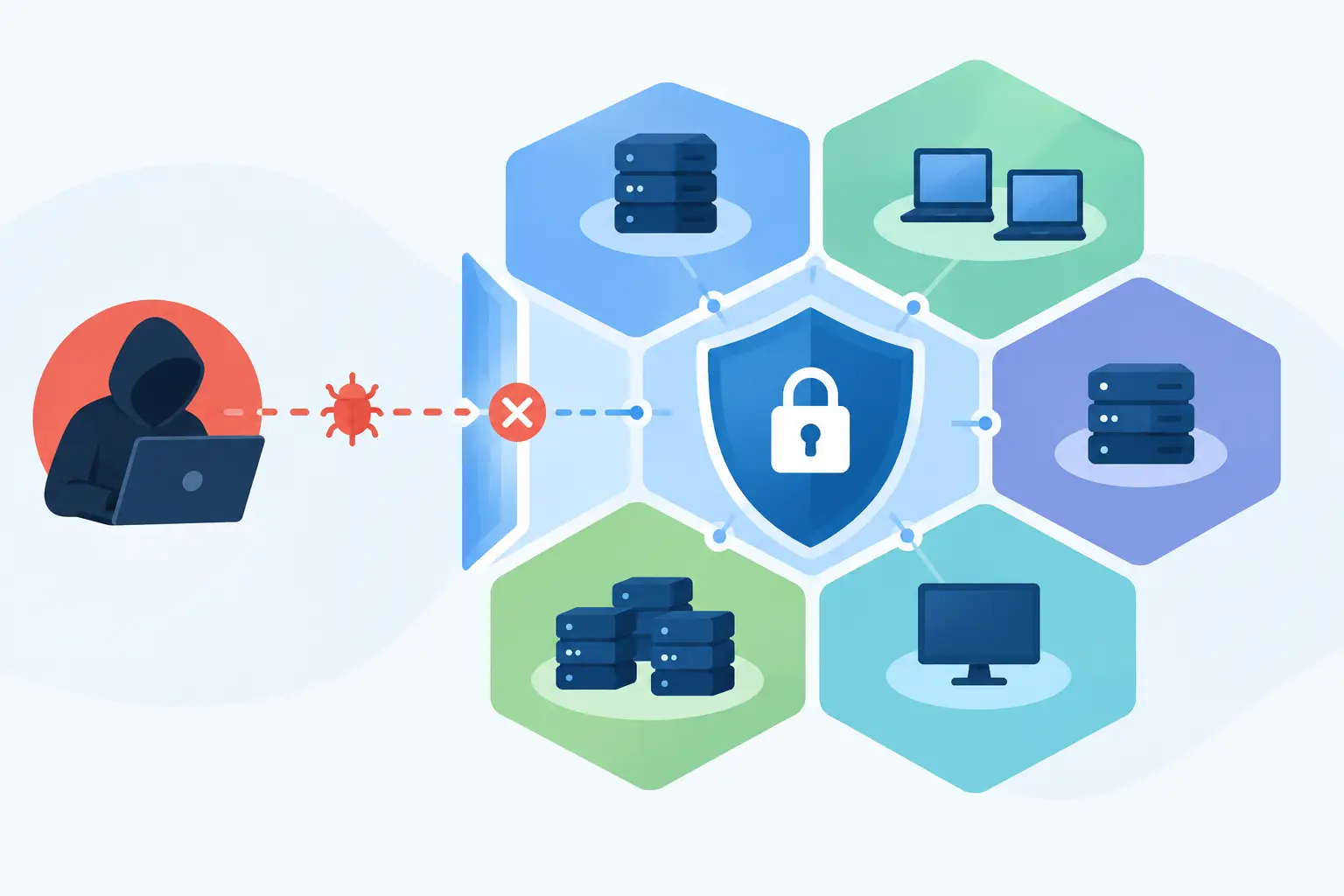
A compromised credential should not become an enterprise-wide incident. Yet in many environments, one stolen administrator password, exposed service account, or infected endpoint can still reach systems far beyond its legitimate purpose. Microsegmentation changes that equation. It places enforceable boundaries around workloads, users, devices, applications, and data so an attacker cannot move freely after gaining an initial foothold.
For organizations responsible for regulated data, production systems, operational technology, and privileged accounts, this is not a network-design exercise. It is a containment strategy. The objective is direct: reduce the blast radius, preserve mission continuity, and give responders control when the perimeter has already been breached.
What Microsegmentation Actually Does
Traditional segmentation divides a network into broad zones: corporate IT, guest wireless, data center, production, development, or operational technology. That structure remains useful, but it is often too coarse for modern attacks. Once an adversary lands inside an approved zone, flat connectivity can turn one compromised system into a launch point for reconnaissance, credential theft, ransomware deployment, and data exfiltration.
Microsegmentation applies policy at a much narrower level. Instead of trusting a workload because it sits on the correct subnet, access is evaluated according to the identity of the requester, the destination, device health, application, protocol, time, data sensitivity, and operational context. A finance application may communicate only with its approved database over a specific port. A contractor's managed device may access one maintenance portal but never a production controller. A service account may perform one defined transaction and nothing else.
The default stance is deny. Connectivity is granted only where a documented business function requires it.
This makes microsegmentation a core enforcement mechanism for Zero Trust. Zero Trust is not achieved by adding multifactor authentication at the edge and trusting everything inside. Every request must earn access continuously. Segmentation gives that principle teeth by ensuring that verified identity alone does not create unrestricted lateral movement.
Why Lateral Movement Is the Real Test
Most sophisticated incidents do not end at initial access. Attackers use phishing, exposed remote services, third-party connections, cloud misconfigurations, and compromised identities to get inside. Their next objective is usually expansion: find high-value assets, elevate privileges, disable defenses, and reach systems that can produce leverage.
Ransomware operators may spend days mapping shares and backups before detonating encryption. An insider with legitimate access may pull sensitive records from systems outside their role. A nation-state actor may use an ordinary user account to move toward engineering workstations, identity infrastructure, or operational technology.
Microsegmentation denies the assumption that internal traffic is inherently trustworthy. If a compromised endpoint attempts to reach a domain controller, backup vault, payroll database, or industrial management system without an explicit policy path, the connection is blocked. That decision can stop an attack chain before it becomes an operational crisis.
Containment also improves incident response. Security teams can isolate a suspected workload, revoke sessions, and tighten policy around a targeted application without shutting down an entire business unit. During an active incident, precision matters. Broad network shutdowns may contain an attacker, but they can also interrupt manufacturing, patient care, logistics, public services, or revenue-generating operations.
Microsegmentation Must Follow the Asset
Network location no longer defines an asset's risk. Enterprise systems operate across data centers, cloud environments, branch offices, remote endpoints, SaaS platforms, and managed service relationships. Workloads move. Users work from different locations. Data is copied, processed, and shared through services that never touch a traditional internal network.
Effective microsegmentation follows the asset rather than relying only on network boundaries. Policy should be portable across hybrid environments and tied to verifiable attributes: workload identity, user role, device posture, application dependency, classification level, and risk score.
This is particularly critical for high-value systems. Privileged access management servers, identity providers, backup infrastructure, source-code repositories, payment systems, electronic records, and industrial control environments require different protections because compromise has different consequences. A single universal policy model is rarely sufficient.
For example, an engineering workstation may need tightly controlled access to a specific operational technology management server during an approved maintenance window. That same workstation should not have open paths to corporate finance systems, internet-facing services, or unrelated plant environments. The rule should persist regardless of whether the workstation is on site, connected through a secured remote session, or moved to another network segment.
Build Policy From Real Business Dependencies
The hardest part of microsegmentation is not creating rules. It is understanding what must communicate, under which conditions, and what can safely be denied. Organizations that begin by blocking traffic without visibility can disrupt critical applications and create resistance from operations teams.
Start with asset and data discovery. Identify crown-jewel systems, privileged accounts, sensitive data stores, business-critical applications, and operational dependencies. Then map observed communications over time. This exposes the connections a workload actually uses, including overlooked service accounts, legacy integrations, scheduled jobs, and vendor access paths.
Next, classify each connection by business necessity. Some traffic is required continuously. Some is needed only for patching, batch processing, backup, or emergency support. Some has no justified purpose at all. Policies should reflect this reality rather than an idealized architecture diagram.
A practical implementation usually progresses in stages. Teams first establish visibility and identify high-risk pathways. They then enforce controls around the most valuable assets and the most dangerous lateral routes, such as access to identity systems, administrative protocols, backup repositories, and sensitive databases. Policy coverage expands as dependencies are verified and exceptions are reduced.
This approach is slower than a blanket block, but it is more durable. Security that interrupts essential operations will eventually be bypassed. Security that supports verified business workflows can become a defensible operating standard.
Identity, Device Trust, and Context Cannot Be Separate
Segmentation based only on IP addresses and ports is increasingly fragile. Cloud workloads receive dynamic addresses. Users access services from managed and unmanaged devices. Attackers can hijack legitimate credentials and use approved channels. A policy engine needs more than a source address to distinguish normal activity from risk.
Strong segmentation evaluates identity and context together. Role-based access control can limit broad access according to job function. Attribute-based access control adds conditions such as device compliance, geographic constraints, data classification, active incident status, and approved change windows. Just-in-time elevation narrows the period in which privileged actions are available.
Authentication quality matters as well. A user who has proven identity through phishing-resistant hardware-backed authentication presents a different risk profile than one authenticated through a weak or compromised factor. Session risk should be reassessed when behavior changes, device posture degrades, or threat intelligence identifies suspicious activity.
This is where monitoring becomes operationally valuable. SIEM analytics, user and entity behavior analytics, endpoint telemetry, DNS inspection, and network visibility can identify a workload trying to establish unfamiliar connections. Automated response can then block the hostile route, revoke a compromised session, or place an asset into a containment policy group. The policy boundary is no longer static. It responds to evidence.
Common Failure Points
Microsegmentation can fail when it is treated as a one-time network project. Application environments change, mergers introduce new infrastructure, cloud services expand, and vendors require access. Without continuous discovery and policy review, approved rules become stale and exceptions multiply.
Another failure point is protecting only servers while leaving endpoints, identities, and management planes broadly connected. Attackers look for the weakest path. If a user endpoint can freely reach administrative services, or if a vendor account has persistent access across environments, server-level controls alone will not contain the threat.
Overly complex policy is also a risk. Thousands of rules with no clear owner, purpose, expiration date, or audit trail create operational blind spots. Mature programs assign responsibility for policy decisions, document the business rationale, monitor violations, and remove access that is no longer required.
The trade-off is real: finer-grained control demands better asset intelligence, disciplined change management, and coordination between security and operations. But the alternative is often hidden complexity in the form of ungoverned trust paths that remain invisible until an attacker uses them.
Measure Containment, Not Just Coverage
Security leaders should not judge microsegmentation by the number of policies deployed or workloads tagged. The question is whether critical attack paths are actually closed.
Measure how many crown-jewel systems have explicitly enforced inbound and outbound communication rules. Track privileged pathways that have been eliminated, unauthorized connection attempts blocked, and time required to isolate a compromised asset. Test whether a simulated attacker who compromises a standard user or endpoint can reach identity infrastructure, backups, sensitive data, or production systems.
Evidence matters for compliance as well. Auditors and regulators need more than a statement that segmentation exists. They need demonstrable policy enforcement, monitored control activity, response records, and proof that exceptions are governed. Signed, timestamped audit evidence turns containment from an architectural claim into a defensible control.
Vulcan Rampart applies this discipline as part of Zero Trust enforcement: verify continuously, deny by default, and contain hostile movement before it can compromise the mission.
A perimeter will eventually be tested. The decisive question is what an attacker can reach after the first system falls. Microsegmentation ensures that one breach does not become permission to take the rest.