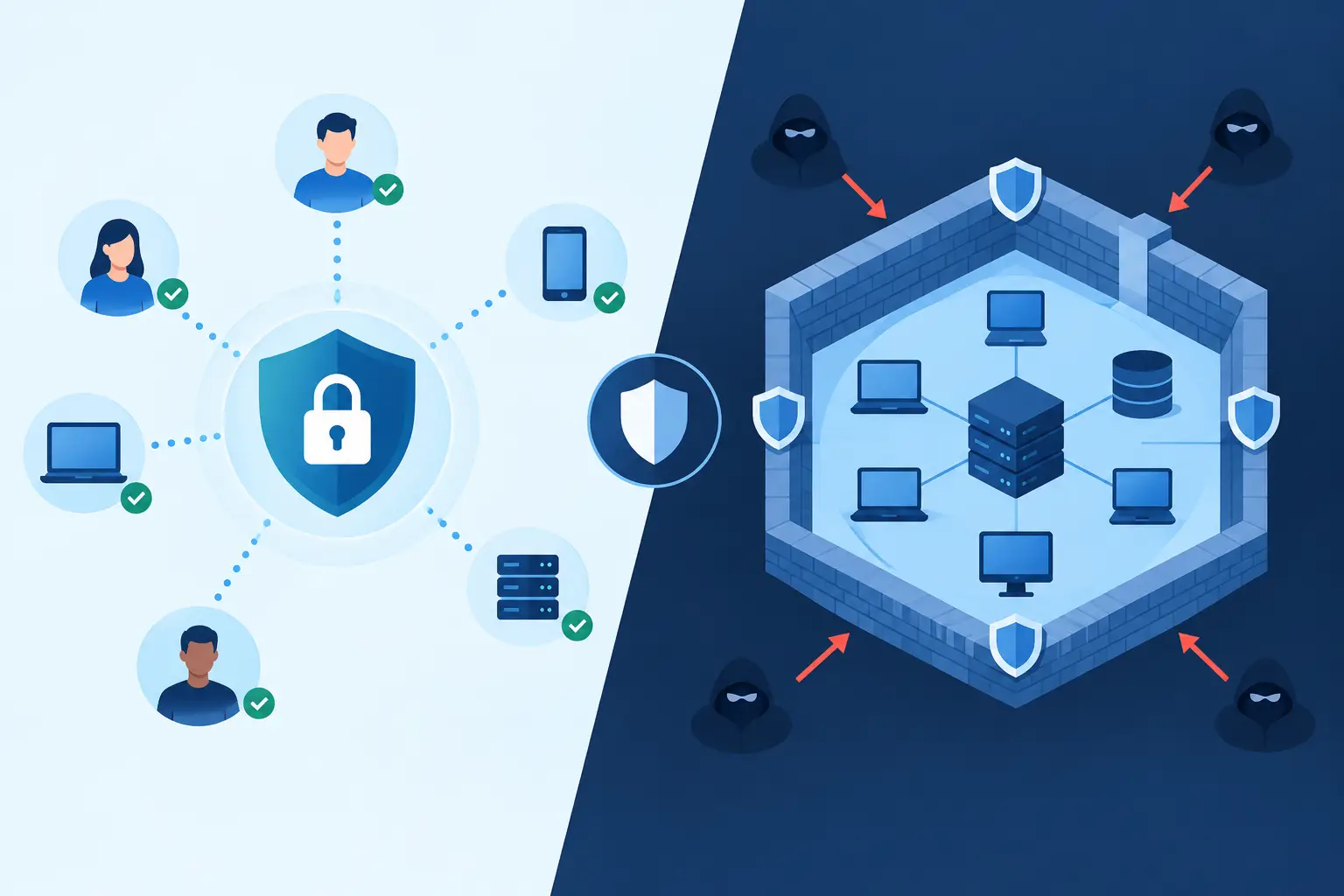
A compromised VPN account should not become a master key to finance systems, production networks, sensitive data, and privileged administration. That is the operational difference behind zero trust vs perimeter security. One model assumes that crossing the boundary establishes a measure of trust. The other treats every request beyond that boundary as a decision that must be earned.
For leaders responsible for continuity, this is not an architecture debate conducted in a slide deck. It determines whether a phishing event, stolen session token, unmanaged device, or malicious insider becomes a contained incident or a business-stopping breach.
Zero Trust vs Perimeter Security: The Core Difference
Perimeter security was built around a straightforward premise: keep unauthorized users out of the network. Firewalls, secure web gateways, VPNs, intrusion prevention, and network segmentation remain valuable controls. They inspect and restrict traffic at the edge, reducing exposure to known threats and unwanted access.
The problem is what happens when the edge is crossed. A user authenticated through a VPN, a contractor connected from a managed laptop, or a workload communicating from an approved subnet may receive more implicit trust than the situation warrants. If credentials are stolen or a trusted endpoint is compromised, an attacker can look like a legitimate insider while moving laterally toward higher-value targets.
Zero Trust changes the question from, “Did this user get inside?” to, “Should this identity, on this device, under these conditions, be allowed to make this exact request right now?” The policy decision is continuous. Identity, device health, location, workload behavior, data sensitivity, and requested privilege all matter.
The default stance is deny. Access is narrowly granted, continuously evaluated, and revoked when the context changes.
What Perimeter Security Still Does Well
Perimeter security is not obsolete. An organization still needs external attack-surface management, firewalls, DNS protection, email security, network detection, secure remote access, and segmentation. These controls reduce noise, block commodity attacks, and create valuable layers of resistance before malicious activity reaches critical assets.
For a small, stable environment with few remote users, limited cloud adoption, and clearly separated systems, a well-managed perimeter can offer meaningful protection. It may also provide a practical first step for organizations replacing exposed legacy services or consolidating internet-facing infrastructure.
But perimeter-centric design has limits that matter in enterprise environments. Modern operations extend across SaaS platforms, cloud workloads, mobile devices, OT environments, suppliers, remote workforces, and machine identities. The boundary is no longer one controlled edge. It is wherever a user, application, service account, or piece of data makes a request.
A perimeter also struggles with insider risk. A malicious employee, a compromised administrator, or an attacker using valid credentials may not trigger controls designed primarily to spot unauthorized entry. The traffic can appear normal until damage is already underway.
Why Zero Trust Reduces Blast Radius
Zero Trust does not claim that compromise will never occur. No credible security program should. Its value is in limiting what a compromised identity or endpoint can reach, detecting behavior that violates policy, and containing activity before it spreads.
A mature Zero Trust architecture enforces least privilege through role-based and attribute-based access controls. A payroll specialist should receive access to payroll functions, not broad access to financial infrastructure. A vendor supporting a single application should not gain standing access to the enterprise network. An administrator should use just-in-time elevation for a defined task and time window, rather than retain persistent privilege.
This approach makes lateral movement harder. Even after an attacker gains access, each new request confronts a separate policy decision. A device that falls out of compliance can lose access. A session showing impossible travel, abnormal data retrieval, or unusual administrative behavior can be challenged, restricted, or terminated.
The difference becomes most visible during an active incident. In a perimeter model, responders may need to isolate broad network segments or shut down remote access to regain control. That can protect the enterprise, but it can also halt operations. With identity-aware policy enforcement and granular segmentation, containment can target the affected user, endpoint, workload, session, or data path while preserving essential business functions.
The Controls That Make Zero Trust Real
Zero Trust is often reduced to multi-factor authentication. Strong MFA is essential, but it is only one control. A security program that adds MFA while leaving excessive privileges, flat networks, unmanaged endpoints, and opaque data flows intact has improved authentication, not completed a Zero Trust transformation.
The model requires coordinated enforcement across identity, devices, networks, applications, workloads, and data. Authentication should resist modern credential attacks through phishing-resistant factors such as WebAuthn or FIDO2 hardware keys, supported by hardened password storage and context-aware access policy. Privileged access should be temporary, approved, monitored, and logged.
Device posture must also influence access. A managed endpoint with current security controls, encrypted storage, and active endpoint detection presents a different risk profile than an unknown device connecting from an unmanaged network. The same principle applies to workloads and service accounts, which must authenticate and operate with narrowly defined permissions.
Data requires its own protection because data moves. Classification, field-level encryption, data loss prevention, and secure sanitization can preserve control when files are downloaded, shared, copied into cloud services, or accessed through an application. The policy must follow the asset, not remain fixed at a network boundary.
Finally, continuous visibility turns policy into defense. SIEM analytics, user and entity behavior analytics, endpoint telemetry, DNS and traffic inspection, and automated threat hunting mapped to MITRE ATT&CK help identify the gap between a valid login and valid behavior. Detection without response is not enough. Automated containment can revoke sessions, block hostile IPs, disable risky access paths, and initiate evidence-preserving response playbooks in minutes.
Trade-Offs Leaders Should Plan For
The choice between zero trust and perimeter security is not a choice between complexity and simplicity. Both demand disciplined operations. The real trade-off is where an organization accepts complexity: upfront in policy design and integration, or later during a breach when responders must determine who and what can still be trusted.
Zero Trust requires an accurate understanding of identities, critical assets, data flows, and access dependencies. Legacy applications may rely on broad network access, shared accounts, or protocols that were never designed for granular policy enforcement. OT environments add safety and availability constraints. A poorly sequenced rollout can disrupt legitimate work, create alert fatigue, and undermine executive confidence.
That is why the starting point should be the mission, not a generic technology checklist. Identify the systems whose outage would stop revenue, operations, safety, or regulated obligations. Map the privileged accounts, vendors, applications, and data paths around those systems. Then apply stronger controls in stages, beginning with the access routes most likely to create enterprise-wide impact.
A practical program often starts by eliminating standing privilege, enforcing phishing-resistant authentication for high-risk users, inventorying unmanaged assets, and separating critical workloads from general user access. From there, continuous monitoring and response automation can improve detection speed without forcing teams to manage every event manually.
Measuring the Security Model That Protects Operations
Executives should not measure progress solely by the number of tools deployed or policies written. The meaningful measures are operational: how quickly can the team detect anomalous access, revoke a compromised session, isolate an endpoint, recover an account, and produce audit-grade evidence of what occurred?
Compliance frameworks can help establish disciplined control coverage, particularly for organizations accountable to FedRAMP, CMMC, NIST, IEC 62443, or sector-specific mandates. Yet compliance alone does not prove that the organization can contain an active intrusion. The decisive test is whether controls work together under pressure.
Vulcan Rampart approaches that test as a mission-defense requirement. A policy engine continuously evaluates access across identity, endpoint, network, and data layers, while automated containment and signed response evidence support rapid action and accountable recovery. The goal is not to make the perimeter disappear. It is to ensure that a broken perimeter does not decide the outcome.
The next breach will not wait for a complete transformation roadmap. Start with the accounts, systems, and data your organization cannot afford to lose, then build controls that keep one compromised connection from becoming a path to the entire mission.