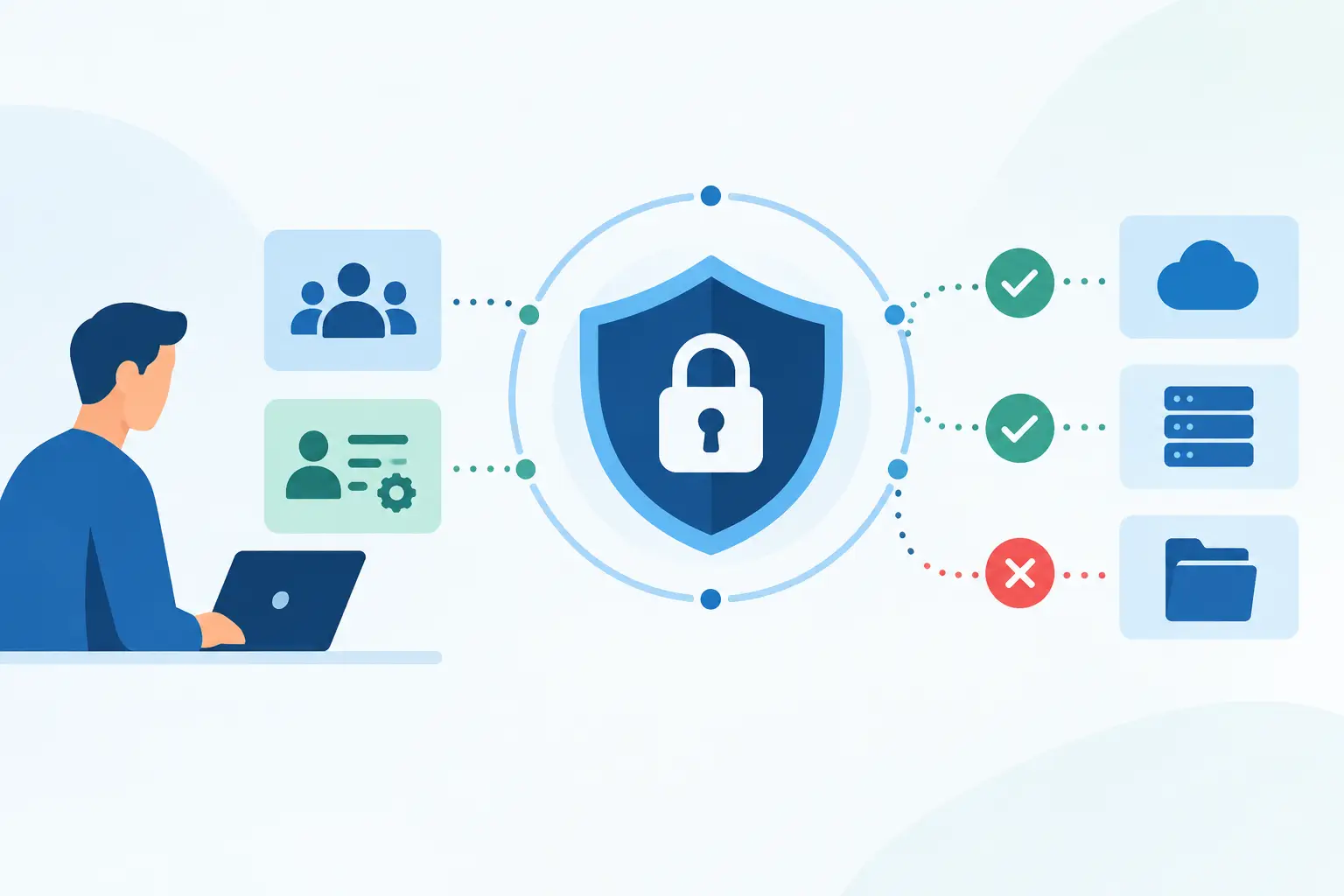
A compromised identity does not need domain-admin rights to cause a mission failure. One over-permissioned finance user, plant engineer, contractor account, or service credential can provide the path from a routine login to data theft, ransomware, or operational disruption. ABAC / RBAC permissions in Zero Trust determine whether that identity can move freely or meets a hard policy boundary.
The objective is not simply to reduce access. It is to make every granted action defensible: the right person, using the right device, for the right purpose, under conditions the organization accepts. When context changes or risk rises, access must contract immediately. That is how permissions become a containment control rather than an administrative afterthought.
Why Permissions Decide the Blast Radius
Zero Trust begins with a default stance of deny. Identity verification matters, but authentication alone answers only one question: who or what is attempting to connect? It does not establish whether the request is appropriate, whether the endpoint is trustworthy, whether the data is sensitive, or whether the session is behaving like an attacker who has stolen valid credentials.
Permissions answer those questions at the moment access is requested. A mature policy decision evaluates identity, entitlement, device posture, location, network conditions, data classification, time, workload, and observed behavior. The decision is not permanent because the session is not permanently trustworthy.
This is where many security programs fail. They deploy strong multifactor authentication, then allow broad role memberships to persist for years. A user may authenticate with a hardware key and still retain unnecessary access to payroll records, production systems, cloud consoles, or sensitive engineering repositories. Strong authentication protects the front door. Precise authorization limits what happens after the door opens.
For enterprises accountable for regulated data or operational continuity, the distinction is material. A contained account compromise is an incident. A compromised account with inherited, excessive permissions can become a business interruption.
RBAC Provides the Operational Baseline
Role-based access control, or RBAC, grants permissions according to a defined job function. A payroll specialist receives access to payroll applications. A security analyst receives access to investigations and security telemetry. A network administrator receives the operational controls required to maintain network services.
RBAC is valuable because it makes access understandable. Security leaders can review a role, identify its intended responsibilities, and apply it consistently across a workforce. It supports onboarding, offboarding, access reviews, audit evidence, and separation of duties without forcing every access decision into a one-off exception.
In high-pressure environments, that clarity matters. During an incident, responders need to know which roles can disable accounts, isolate endpoints, change firewall policy, recover systems, or access forensic evidence. Well-designed roles shorten decision time while reducing the risk that response actions create a second outage.
RBAC has limits, however. Roles tend to accumulate. A staff member changes departments but retains old groups. A team creates a broad "administrator" role because granular design takes time. Contractors receive a role intended for permanent employees. Over time, role sprawl turns least privilege into a paper policy.
RBAC also cannot naturally account for changing conditions. A database administrator may need production access during an approved maintenance window from a managed workstation, but not at 2:00 a.m. from an unmanaged device in an unexpected location. The role is valid. The request may not be.
ABAC Makes Context a Security Control
Attribute-based access control, or ABAC, grants or denies access based on attributes associated with the subject, resource, action, and environment. Instead of asking only, "Is this user an administrator?" ABAC asks a more useful question: "Should this administrator perform this action on this resource under these conditions?"
User attributes can include clearance, department, employment status, training status, and incident-response assignment. Resource attributes can include data classification, system criticality, owner, and regulatory scope. Environmental attributes can include device compliance, location, session risk, time of day, network trust, and active threat intelligence.
That context enables policies that match real operational risk. A procurement manager may read internal contract records from a compliant corporate device but be blocked from exporting controlled data to an unmanaged browser session. An engineer may access a production asset only through a segmented management network, during an approved change window, after completing a step-up authentication challenge. A privileged user whose behavior triggers a high-risk UEBA score can lose elevation before an attacker reaches critical systems.
ABAC is particularly effective where data moves across cloud services, remote teams, vendors, mobile devices, and operational networks. It lets controls travel with the resource rather than relying on a fixed network location. That is essential when the perimeter is no longer a reliable security boundary.
The trade-off is governance. ABAC depends on trustworthy attributes and disciplined policy design. If asset owners misclassify data, HR systems contain stale employment information, device-management signals are incomplete, or policy logic becomes opaque, the organization can create access friction without gaining meaningful protection. Context is powerful only when it is accurate, monitored, and explainable.
ABAC / RBAC Permissions in Zero Trust Work Together
The strongest model is not ABAC versus RBAC. It is RBAC for stable entitlement and ABAC for continuous, risk-aware enforcement.
RBAC establishes what a person or workload would normally be allowed to do. ABAC evaluates whether that allowed action should proceed in the current session. The role may grant a help-desk engineer permission to reset passwords. Attribute-driven policy can require a managed device, verified ticket reference, low session risk, and a prohibition on resetting privileged accounts without a second approval.
This combined approach also protects service identities, which are frequently overlooked. A workload identity should not receive broad standing access merely because an application requires occasional database access. Its policy can restrict calls to a named application, a specific dataset, a known runtime environment, approved network paths, and a defined transaction type. If the workload begins making unusual requests, the policy engine should deny or constrain access while security operations investigates.
For privileged access, just-in-time elevation adds another boundary. Administrators receive elevated permissions only for a narrow task and a limited window. The elevation can require stronger authentication, an approved request, and continuous monitoring throughout the session. Once the work is complete or risk conditions change, privileges expire. There is no reason for a dormant administrative entitlement to remain available for an attacker to inherit.
Build Policies Around Assets and Failure Modes
Permission architecture should begin with the systems and data the organization cannot afford to lose, not with an abstract catalog of user groups. Identify mission assets, privileged control planes, sensitive repositories, production workloads, operational technology, and recovery infrastructure. Then identify the identities and workflows that legitimately touch them.
For each critical access path, define the acceptable conditions. Who needs access? What action is necessary? Which device and network posture are required? Is access read-only, change-capable, or export-capable? What additional controls apply when the system is under incident response, the user is remote, or the data is regulated?
Avoid trying to perfect every entitlement at once. Start where over-permissioning creates the highest consequence: domain administration, cloud tenancy administration, identity systems, backup platforms, security tooling, financial systems, source-code repositories, and production control environments. Reducing standing privilege in these areas immediately narrows the attacker’s options.
Policy testing is equally critical. A deny decision that stops an attacker is valuable. A deny decision that blocks emergency operations without an accountable break-glass process can be damaging. Break-glass access should be narrowly controlled, strongly authenticated, time-bound, continuously observed, and followed by automatic review. Emergency access is not an exception to Zero Trust. It is a high-risk workflow that requires stronger proof and better evidence.
Enforce, Monitor, and Prove Every Decision
Permissions cannot remain static entries in an identity directory. They require continuous evaluation against endpoint posture, behavioral analytics, threat intelligence, data classification, and active incidents. When a device falls out of compliance, a session is hijacked, or activity conflicts with normal behavior, access policy must be able to revoke tokens, reduce permissions, isolate the endpoint, or trigger containment workflows.
This is where authorization joins detection and response. A policy engine that can make an access decision but cannot act on high-confidence threat signals leaves containment too slow. Security teams need the ability to revoke compromised sessions, block hostile infrastructure, suspend risky privilege elevation, and preserve signed evidence of what happened and why.
Vulcan Rampart applies this inside-out enforcement model across identity, endpoint, network, and data layers, combining RBAC, ABAC, continuous monitoring, and automated response. The result is not merely a cleaner access model. It is a defensive bulwark built to keep one compromised identity from becoming an enterprise-wide failure.
The permission question every executive should press is simple: if a valid credential is stolen this afternoon, what can it reach before your controls intervene? Build the answer around least privilege, live context, rapid containment, and evidence that holds when the mission is tested.