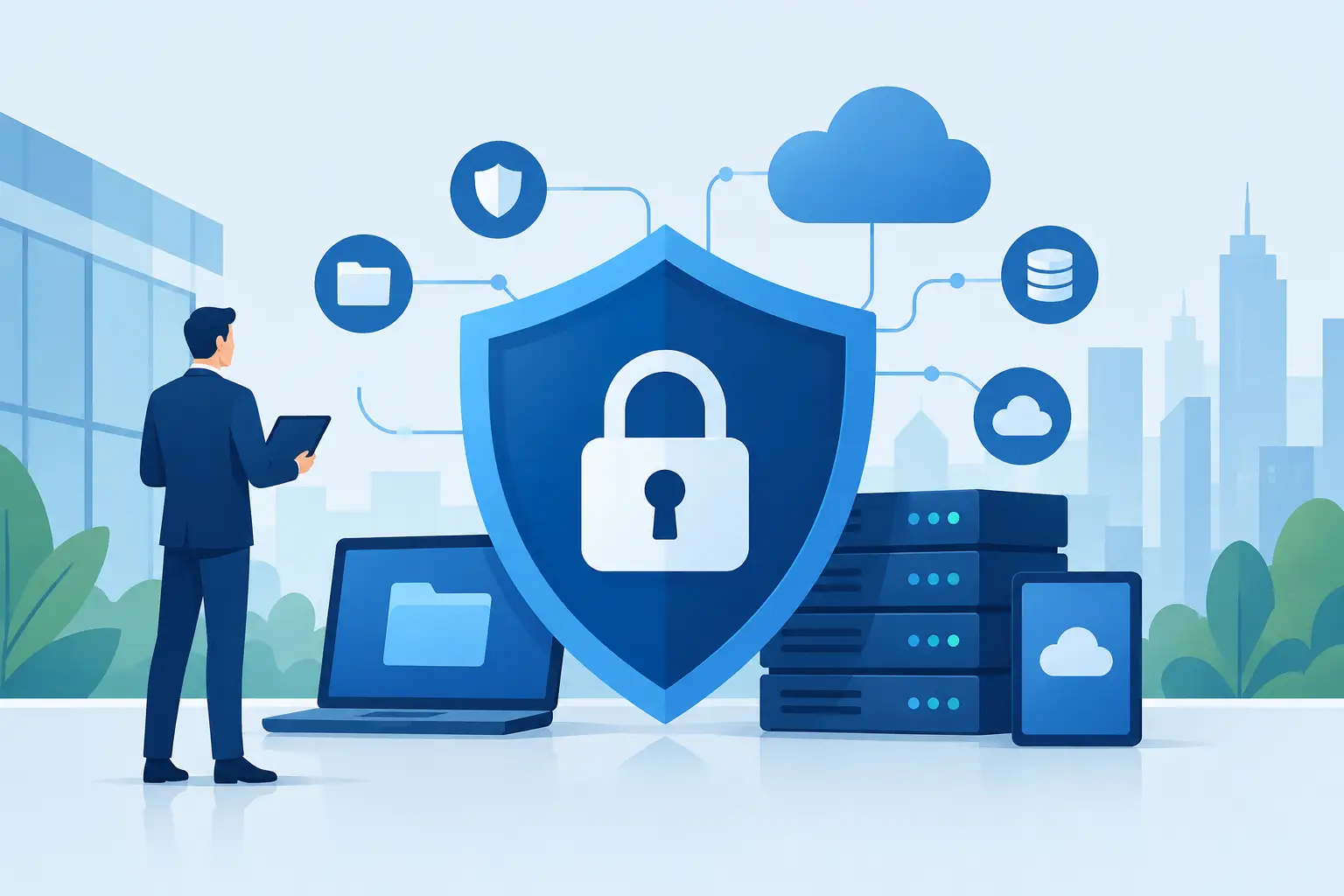
A payroll administrator’s session token. A production control server. The source code that differentiates a product. A domain administrator account no one has reviewed in two years. These are not merely IT resources. They are mission assets, and a single exposed one can stop operations, trigger disclosure duties, or hand an attacker a path through the enterprise.
This digital asset protection guide is built for leaders who need security to hold under pressure. The goal is not to build a higher perimeter and hope it lasts. It is to identify what the organization cannot afford to lose, control access continuously, detect hostile behavior early, contain it decisively, and recover with evidence intact.
Define what must be defended first
Many protection programs begin with tools. That is backward. Start with the assets that carry business consequence. A customer database and a break-room display may both be connected to the network, but they do not warrant the same controls, recovery objectives, or executive attention.
Your asset inventory should connect technical objects to operational outcomes. Identify the systems, accounts, data stores, integrations, devices, and third parties whose loss of confidentiality, integrity, or availability would materially affect revenue, safety, contractual obligations, or the ability to operate.
For most enterprises, the priority set includes:
- Privileged identities, service accounts, API keys, and administrative consoles
- Sensitive data, including regulated records, intellectual property, financial data, and credentials
- Production platforms, cloud tenants, core network services, and backup infrastructure
- Operational technology, industrial control systems, and remote-access pathways
- Third-party connections and SaaS platforms with access to internal data or workflows
Classification must be more than a spreadsheet exercise. An asset that moves between endpoints, cloud services, collaboration platforms, and vendors should retain its sensitivity label and protection requirements. Field-level encryption, data loss prevention, and policy-based handling help ensure the data remains protected after it leaves its original repository.
Ownership matters as much as discovery. Every crown-jewel asset needs a business owner who can answer a difficult question quickly: if this system is unavailable or exposed, who has authority to make the trade-offs required to restore operations? During an incident, ambiguity costs time.
Apply Zero Trust to digital asset protection
A traditional network trusts too much once a user or device gets inside. That model fails when credentials are stolen, a vendor connection is abused, or an insider misuses legitimate access. The attacker does not need to defeat every control. They need one trusted foothold.
Zero Trust changes the decision point. Every user, device, request, session, and packet is evaluated against identity, context, device health, location, risk, and requested action. The default stance is deny. Access is earned, constrained, and continuously re-evaluated.
For leadership teams, the practical question is not whether to “adopt Zero Trust” as a label. It is whether high-value access is governed by enforceable policies that reduce blast radius. That means role-based access control for baseline duties, attribute-based access control when context matters, and just-in-time elevation for administrative tasks. A finance analyst should not inherit server administration rights simply because the account belongs to a trusted employee. An administrator should not hold standing privilege when a narrowly scoped, time-bound elevation will do.
Strong authentication is nonnegotiable, but it is not the whole defense. Hardware-backed WebAuthn or FIDO2 keys materially reduce phishing risk. Password protection should use modern hashing such as Argon2id, while additional factors can support recovery and specific risk scenarios. Organizations protecting long-lived sensitive data should also account for post-quantum cryptography, because encrypted material stolen now may be targeted for decryption later.
There is a trade-off. Tighter access policies can frustrate teams if they are rolled out without workflow analysis. Start with privileged accounts, remote access, sensitive data repositories, and systems that control production. Measure where policy blocks legitimate work, then refine permissions without weakening the control objective. Security that users route around is not a control.
See the attack across every layer
Asset protection cannot depend on a single alert console. Sophisticated incidents move across identity, endpoint, network, data, cloud, and SaaS layers. A suspicious sign-in may be the first signal. The damage may occur later, when the attacker creates a mailbox rule, accesses a file share, changes an endpoint policy, or uses a service account to reach a production workload.
Centralized security analytics should correlate telemetry from endpoints, identity providers, DNS, network traffic, cloud platforms, mobile-device management, and data controls. User and entity behavior analytics can surface deviations that signature-based detection misses, such as an executive account accessing an unusual repository at an unusual hour or a service identity suddenly making interactive logins.
Threat hunting should be deliberate rather than occasional. Map hunt scenarios to known adversary behaviors, including credential access, lateral movement, persistence, command and control, data staging, and exfiltration. MITRE ATT&CK provides a useful common language, but a mapping alone is not protection. The organization must confirm that the required data is collected, detections are tested, and responders know which action to take.
Generative AI expands this requirement. Sensitive data can leave through prompts, connected applications, plugins, and unapproved tools. Detection should account for prompt injection, risky integrations, abnormal bulk transfers, and attempts to use AI workflows to bypass data handling rules. The right response depends on the use case: a blanket ban may push employees toward unmanaged services, while unrestricted use can expose regulated data. Clear approved paths and enforceable controls are stronger than wishful policy.
Contain in minutes, not after a committee meeting
The value of detection is measured by what happens next. When an account is compromised, an analyst should not need to open tickets, wait for manual approval, and notify six teams before revoking access. For clearly defined high-confidence events, automated response can block hostile IP addresses, terminate sessions, isolate affected endpoints, disable tokens, and launch containment workflows across integrated tools.
Automation requires judgment. Auto-blocking a confirmed malicious infrastructure indicator is often appropriate. Automatically disabling the account that runs a hospital workflow or a manufacturing line may create a second incident. Build playbooks around asset criticality, confidence level, operational impact, and rollback options. High-risk actions should escalate to accountable responders with the context needed to decide fast.
Every containment action should generate signed, timestamped evidence. This supports internal review, incident reconstruction, legal obligations, cyber insurance requirements, and regulator scrutiny. It also exposes weak spots in the response process. If the team cannot establish who revoked a session, why it happened, and what the system state was before the action, the organization is operating without defensible control.
Make recovery part of the protection model
Recovery is not a final phase after security has failed. It is a control that determines whether an incident becomes an operational crisis. Ransomware actors increasingly target backup systems, identity infrastructure, recovery credentials, and management planes because they understand that an organization without a clean way back has fewer choices.
Protect backups with separate administrative identities, immutability where appropriate, network segmentation, encryption, and recurring restore tests. Testing matters because a backup that exists but cannot be restored within the required recovery window is not protection. Include identity recovery in the plan. Restoring servers while leaving compromised privileged accounts, federation settings, or authentication tokens in place can return the attacker to the environment.
Practice the decisions executives will need to make: which services return first, when to notify customers and regulators, how to preserve forensic evidence, and who can authorize a shutdown of a business process. A recovered environment should be cleaner than the one that was compromised, not merely online again.
Govern the suppliers, exceptions, and evidence
Your controls extend only as far as your least governed connection. Vendors may process sensitive data, administer systems, host workloads, or maintain remote access that bypasses ordinary employee controls. Assess them before onboarding, but do not treat a questionnaire as permanent assurance. Continuously review access, changes in risk, exposed credentials, and the data they hold.
Exceptions deserve the same discipline. Temporary broad access, legacy protocols, unsupported systems, and emergency vendor accounts often become permanent attack paths. Record the business justification, compensating controls, expiration date, and named owner for every exception. If no owner will accept that responsibility, the exception should not exist.
For regulated organizations, compliance evidence should emerge from operating controls, not a scramble before an audit. When policies, telemetry, remediation actions, and access decisions are continuously documented, alignment with frameworks such as FedRAMP, CMMC, NIST, and industrial security requirements becomes more credible and less disruptive.
Vulcan Rampart applies this operational discipline through continuous monitoring, policy enforcement, automated containment, and audit-grade evidence designed for organizations where downtime is not an acceptable outcome.
The decisive test of digital asset protection is the day a trusted identity is misused, a supplier connection turns hostile, or an attacker reaches the edge of a production system. Know what matters most. Deny access by default. Watch every meaningful layer. Act with authority when the signal is clear. The rampart holds when the mission is under fire.