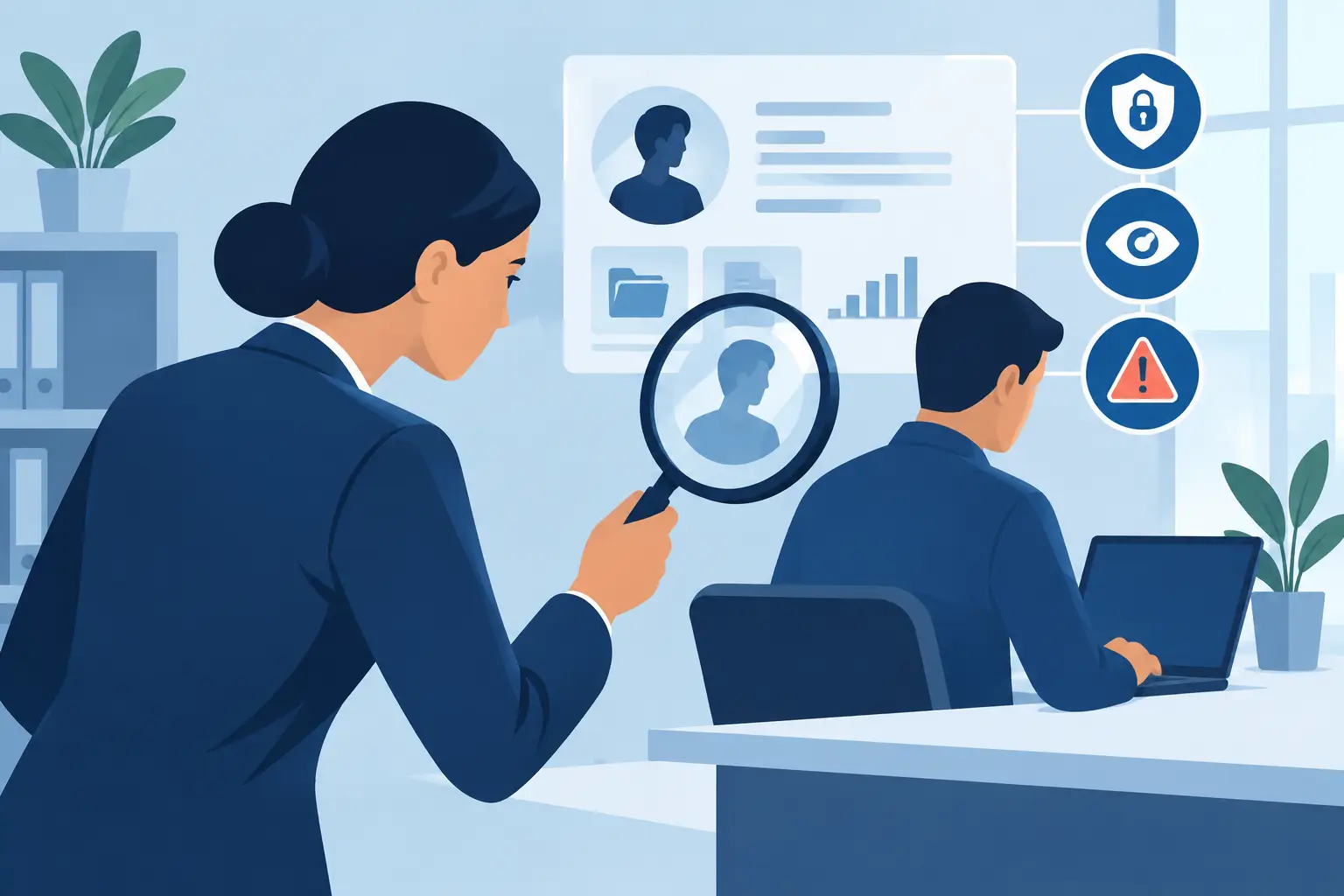
An insider incident rarely begins with an obvious alarm. It may look like a departing engineer downloading project files, a privileged administrator accessing systems at an unusual hour, or a compromised employee account moving laterally through the environment. Knowing how to investigate insider threats means separating ordinary work from behavior that puts the mission at risk, without destroying evidence, alerting the subject too early, or interrupting critical operations.
The objective is not to prove intent in the first hour. The objective is to contain risk, preserve facts, and establish a defensible path to resolution. For organizations responsible for regulated data, production environments, operational technology, or privileged accounts, speed and discipline must work together.
Start the Insider Threat Investigation With Triage
Treat the initial report as an operational decision, not a personnel rumor. Record who reported the concern, what was observed, when it occurred, which identities and assets may be involved, and whether sensitive data or essential systems are exposed. Preserve the original alert, ticket, email, or report in its native form.
Then assess immediate business impact. A user exporting customer records to an approved system may require review. A user exporting the same records to personal cloud storage while attempting to disable endpoint controls may require immediate containment. Context determines the response.
Triage should answer three questions quickly: Is the activity still occurring? Can the identity reach high-value assets? Is there evidence of data loss, sabotage, fraud, or external coordination? If the answer to any is yes, bring incident response, legal counsel, human resources, and the accountable business owner into a controlled escalation process.
Do not assume an insider threat is malicious. Negligence, credential theft, policy confusion, and urgent operational work can produce suspicious signals. But do not let uncertainty become a reason for delay. A measured investigation can protect both the organization and the employee while facts are established.
Contain Access Without Destroying Evidence
Containment is a risk decision. The wrong move can tip off a malicious actor, disrupt a plant floor, or erase the telemetry needed to understand what happened. The right move narrows the blast radius while preserving the ability to investigate.
For an active risk involving privileged access, revoke current sessions, suspend just-in-time elevation, rotate exposed credentials, and require stronger authentication before further access is granted. If a device is suspected, isolate it from sensitive networks while maintaining forensic visibility. Avoid powering it off unless there is a safety or operational reason to do so. Memory, active processes, network connections, and unsaved artifacts can disappear when a system is shut down.
Containment should be tailored to the environment. A finance user may be removed from payment platforms without affecting the enterprise. An administrator supporting a critical service may require supervised access, a temporary replacement, and a maintenance window. In operational technology, abrupt isolation can create availability and safety consequences. Coordinate with operations before making changes that could affect production.
Every containment action should be logged with the time, operator, reason, approval, and outcome. Signed, time-stamped records protect chain of custody and give leadership evidence they can use with regulators, insurers, customers, or counsel.
Build a Timeline Across Identity, Endpoint, Network, and Data
Insider investigations fail when teams examine one data source in isolation. A suspicious file transfer is only one event. The full story may include a new device enrollment, a privileged role assignment, access to an unusual shared drive, a cloud upload, and a login from a location inconsistent with the employee's normal pattern.
Build a single timeline beginning before the triggering event. For a high-risk case, review at least the preceding 30 days, then extend the period if the evidence suggests preparation or recurring activity. Correlate identity-provider logs, privileged access records, endpoint telemetry, VPN and DNS activity, network flows, cloud audit logs, file access histories, DLP alerts, collaboration tools, and physical-access records where lawful and relevant.
User and entity behavior analytics can accelerate this work by identifying deviations from an established baseline. It should not be treated as a verdict. A behavioral score is an investigative lead, not proof of wrongdoing. Analysts still need to validate the business context, approved changes, assigned projects, travel, shift schedules, and authorized data movement.
The same rule applies to artificial intelligence activity. Investigate whether sensitive content was submitted to public or unapproved generative AI tools, whether prompts contained source code or regulated information, and whether the user had a legitimate business purpose. Rogue-AI exposure can be an insider-risk event even when no employee intended harm.
Preserve Evidence That Will Withstand Scrutiny
An insider incident may become an employment action, a civil dispute, a regulatory matter, or a criminal referral. Evidence handling must reflect that possibility from the start.
Create a case record that identifies the evidence source, collector, collection time, method, hash value where applicable, storage location, and every person who accessed it. Preserve original logs and forensic images as read-only evidence. Analysts should work from verified copies.
Keep the investigation scope proportionate. Collect data relevant to the suspected conduct and follow applicable privacy, labor, contractual, and jurisdictional requirements. Legal counsel should guide monitoring boundaries, employee notices, cross-border data handling, and interview strategy. Overcollection can create its own legal and ethical exposure, particularly when personal devices, personal accounts, or unionized workforces are involved.
Avoid editing logs, rewriting notes after the fact, or combining conclusions with raw observations. Write what the evidence shows. For example: "The account accessed 14 restricted files between 9:12 p.m. and 9:24 p.m. and initiated an encrypted upload to an unapproved domain." Reserve intent-based language until it is supported by facts.
Interview and Escalate at the Right Moment
Interviews can clarify the case or compromise it. Do not confront the subject before the team understands the access path, has preserved volatile evidence, and has contained any immediate risk. A premature interview may cause the subject to delete files, alert collaborators, or alter their story around gaps in the evidence.
Plan interviews with human resources and counsel. Use factual, open-ended questions first: What work required access to this repository? Which device did you use? Why was this file transferred? Compare responses to the timeline rather than revealing all evidence at once.
If the matter involves fraud, trade-secret theft, violence, extortion, or a suspected external adversary, engage appropriate law enforcement through counsel and preserve the chain of custody. Security teams should not conduct amateur criminal investigations. Their role is to secure the enterprise, document facts, and support authorized investigators.
Eradicate the Access Path and Recover With Control
Closing the case is more than disabling one account. Determine how the risky behavior was possible. Was access broader than the employee's role required? Did a shared administrator credential defeat accountability? Did an offboarding gap leave access active? Did data classification fail to apply controls to sensitive files?
Correct the control failure at its source. Reduce standing privilege through role-based and attribute-based access controls. Require just-in-time elevation for administrative work. Enforce phishing-resistant authentication, verify device posture continuously, and apply DLP and encryption to sensitive data wherever it moves. Review service accounts, API keys, shared folders, third-party access, and unmanaged endpoints for equivalent pathways.
This is where Zero Trust changes the investigation from a one-time response into a stronger defensive position. Every request should be evaluated against identity, device condition, location, sensitivity, and current risk, rather than granted because the user passed a network boundary hours earlier. Vulcan Rampart applies this inside-out posture to help teams contain compromised sessions, preserve audit-grade evidence, and restore controlled operations.
Turn the Case Into an Operational Improvement
A completed investigation should produce decisions leadership can act on: what happened, which assets were exposed, what was contained, what remains uncertain, and which owners are accountable for remediation. Share only what each audience needs. Executives need business impact and decisions. Security teams need technical findings. HR and counsel need factual documentation. Regulators may need evidence that controls operated and corrective action was taken.
Measure the response as seriously as the incident. Track time to detect, time to contain, scope of affected access, evidence completeness, and recurrence of the same control gap. If the same issue returns, the organization has not finished remediation.
The strongest insider-threat investigations do more than identify a person or close a ticket. They prove that the organization can protect its people fairly, defend its mission assets under pressure, and keep operations moving when trust is tested.