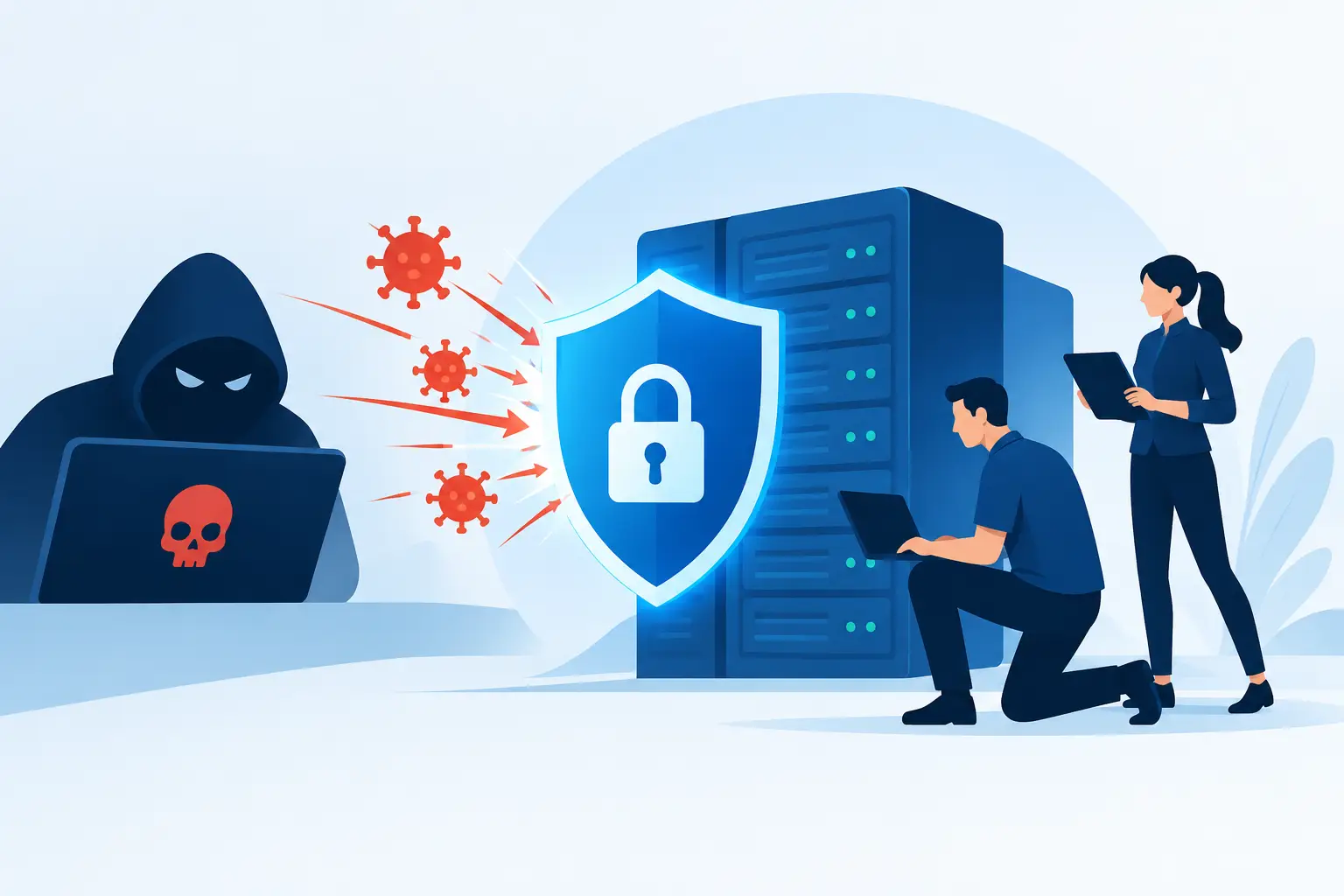
A ransomware event does not begin when the ransom note appears. It begins when an attacker gains enough access to encrypt systems, steal data, disable recovery paths, or threaten the people responsible for keeping operations moving. Ransomware response services exist for that moment: to establish command, contain the threat, protect evidence, and restore the assets the enterprise cannot afford to lose.
For executives and security leaders, the issue is not whether an incident can be solved with a checklist. It is whether the organization can make sound decisions while systems are failing, customers are calling, and the attacker may still be inside. The right response turns a chaotic intrusion into a controlled operation.
What Ransomware Response Services Must Deliver
A credible ransomware response is not simply malware removal or a backup restoration project. It is a coordinated incident operation that addresses the full attack path: compromised identities, lateral movement, persistence mechanisms, encrypted systems, stolen data, and the business consequences of interrupted operations.
The first objective is containment. Responders need to determine what is actively under attacker control and cut off that access without blindly shutting down the systems needed for recovery. This may mean revoking active sessions, disabling or restricting privileged accounts, isolating endpoints, blocking hostile infrastructure, and segmenting affected network zones. Speed matters, but indiscriminate action can destroy volatile evidence or interrupt a production process that must remain safely online.
The second objective is scope. A ransom note is rarely a reliable indicator of what happened. Attackers may have had access for days or weeks before encryption. They may have copied sensitive data, created alternate administrator accounts, modified identity policies, deployed remote tools, or embedded persistence in systems that appear untouched. Response teams must establish what happened, when it happened, and which assets, accounts, applications, and data stores are at risk.
The third objective is recovery with confidence. Restoring an encrypted server before eliminating the attacker’s access can create a cycle of reinfection. Restoring accounts without understanding how credentials were obtained can return privileged access to the adversary. Recovery must be sequenced, validated, and monitored.
The First Hours Set the Direction
The opening hours of an incident determine whether the organization is merely reacting or regaining control. Leadership needs a single decision structure that connects technical responders, legal counsel, business operations, insurance stakeholders, and executive leadership. Conflicting instructions from separate teams slow containment and create gaps the attacker can exploit.
A disciplined response starts by preserving facts. Security logs, endpoint telemetry, identity events, firewall records, cloud audit trails, and system images can reveal the attacker’s route through the environment. Those records also matter for regulatory reporting, insurance claims, contractual obligations, and possible law-enforcement engagement. Evidence that is incomplete, altered, or impossible to trace can turn an already serious event into a governance failure.
Communication requires equal discipline. Attackers often monitor email, collaboration platforms, and administrative tools before or during an attack. Sensitive coordination should move to a secure incident channel that is outside the compromised environment. Leaders should establish who can authorize containment actions, who communicates with employees and customers, and what information can be shared before the facts are confirmed.
The practical question is not whether every system should be taken offline. It depends on the threat, the safety implications, the attacker’s level of access, and the availability of clean recovery options. A hospital, manufacturer, utility operator, or defense supplier may need to keep critical operations running while isolating the portions of the environment that are compromised. That requires responders who understand both cyber containment and operational continuity.
Why Identity Is Often the Decisive Battlefield
Modern ransomware operations are frequently identity attacks before they become encryption attacks. A compromised administrator account can give an adversary the ability to distribute malware, disable security tools, access backups, create new identities, and move across cloud and on-premises environments.
That is why effective ransomware response services place identity at the center of containment. Teams should examine privileged accounts, service accounts, identity-provider logs, conditional-access rules, multifactor authentication changes, and newly created administrative roles. They should also look for less obvious paths, such as delegated permissions, token theft, remote management tools, and stale accounts with elevated access.
During recovery, access should not simply be switched back on. The safer path is to rebuild trust deliberately. Reset credentials based on risk, revoke tokens and sessions, enforce phishing-resistant authentication, limit administrator privileges, and use just-in-time elevation for sensitive actions. Role-based and attribute-based access controls can narrow the blast radius if an account is compromised again.
The default stance should be deny until identity, device health, context, and purpose have been verified. That is Zero Trust applied under pressure, not as a theoretical architecture exercise.
Recovery Is a Campaign, Not a Restart Button
Business leaders understandably want systems restored immediately. Yet fast recovery and safe recovery are not always the same thing. The right sequence depends on which services are mission-critical, which backups are verified clean, and whether the recovery environment can be separated from the original attack path.
A recovery plan should prioritize the systems that enable the organization to operate: identity infrastructure, core network services, production applications, operational technology support systems, customer-facing platforms, and data repositories that support essential decisions. Each restored asset should be tested for signs of persistence, monitored for suspicious activity, and returned to production through controlled access paths.
Backups are vital, but their existence is not proof of recoverability. Responders need to know whether backups were reachable by the attacker, whether they contain corrupted or encrypted data, whether restoration procedures have been tested, and how long a full restoration will take. Immutable, offline, or logically isolated backups offer stronger protection, but they still need validation.
Data theft adds another layer. If attackers exfiltrated regulated, proprietary, or customer information, encryption recovery alone does not resolve the incident. The organization may need to assess notification obligations, contractual exposure, extortion risk, and the possibility that stolen data will be released later. Leaders need evidence-based answers, not assumptions driven by the ransom demand.
What to Expect From a Response Partner
The best ransomware response services combine technical depth with command discipline. They should be capable of investigating endpoint, network, identity, cloud, and data-layer activity at the same time. They should integrate with the security tools already in place rather than demand a clean-room environment that does not exist during a crisis.
Look for responders who can contain threats across tools and produce a defensible record of every significant action. Automated orchestration can accelerate high-confidence actions such as blocking hostile IP addresses, isolating endpoints, revoking compromised sessions, and triggering containment playbooks. Automation is valuable when it is governed. The organization still needs experienced operators to judge business impact, interpret ambiguous evidence, and authorize consequential decisions.
A capable partner should also plan beyond the immediate incident. The final deliverable cannot be a generic report that says to improve awareness training. It should identify the initial access path, affected assets, attacker persistence, control failures, recovery decisions, and prioritized remediation. For regulated organizations, that work should map directly to the controls and evidence expected by frameworks such as FedRAMP, CMMC, NIST SP 800-53, NIST SP 800-82, and IEC 62443.
Vulcan Rampart approaches active incidents from the same operating principle that guides its Zero Trust security posture: detect in seconds, contain in minutes, resolve. Native analytics, behavior monitoring, threat hunting mapped to MITRE ATT&CK, and automated containment can give responders the visibility and force needed to hold the line while recovery begins.
Prepare Before the Ransom Note Appears
The most valuable ransomware response work happens before an attacker forces the issue. Establish and test an incident command structure. Identify the systems, accounts, data, and operational processes that are essential to the mission. Verify backup restoration times. Preapprove emergency access procedures. Confirm that logging is retained and accessible outside the systems most likely to be targeted.
Just as important, rehearse the difficult decisions. Who can authorize isolation of a business unit? When should privileged credentials be reset enterprise-wide? How will operational teams function if email or identity services are unavailable? What evidence must be preserved before rebuilding begins? A tabletop exercise will not stop ransomware, but it exposes the delay and confusion that attackers count on.
The measure of a ransomware response is not whether an organization receives a report after the event. It is whether the mission continues, the attacker loses control, and leadership can account for every decision made under fire. Build the command structure, recovery discipline, and Zero Trust controls before the perimeter breaks. When it does, the rampart must hold.