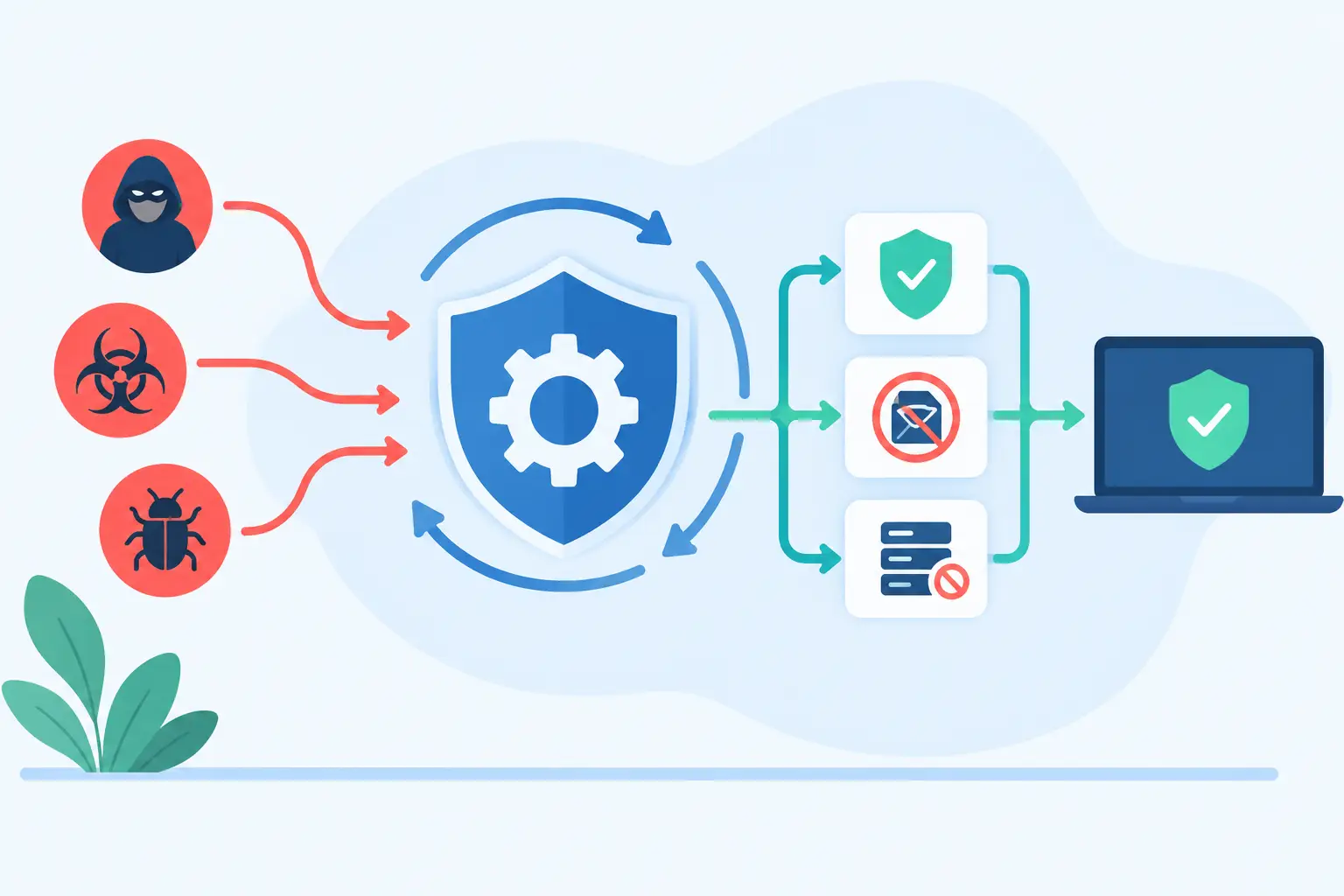
A privileged account signs in from an unfamiliar device at 2:13 a.m., then begins querying file shares it has never touched. At 2:16, a human analyst may still be sorting alerts. At 2:17, ransomware may already be moving laterally. The ability to automate threat containment workflows determines whether that activity becomes a contained security event or an operational crisis.
For enterprises running regulated workloads, production infrastructure, sensitive data, or operational technology, speed without control is not enough. Automated containment must act on credible evidence, restrict the attacker's options, preserve the facts, and keep essential systems running. The objective is direct: detect in seconds, contain in minutes, resolve without surrendering the mission.
Why threat containment cannot wait for a queue
Most security teams do not suffer from a lack of telemetry. They suffer from a gap between detection and decisive action. Endpoint alerts, identity signals, DNS events, cloud logs, and user behavior anomalies often land in different consoles with different severity scores. An attacker benefits from every handoff, every unanswered question, and every alert left for the next shift.
Containment automation closes that gap by connecting a validated signal to a defined response. It can revoke a suspicious session, disable a compromised account, isolate an endpoint, block a hostile IP address, restrict access to sensitive data, or require step-up authentication before privileged activity continues.
That does not mean every alert deserves an automatic shutdown. A failed login from an executive traveling internationally is not the same as a privileged account authenticating from an unmanaged device while accessing engineering drawings at an unusual volume. The difference is context. Effective automation uses identity, device posture, location, behavior, asset criticality, and current threat intelligence to make a policy decision that fits the risk.
How to automate threat containment workflows without creating disruption
The strongest workflows are built around a simple principle: automation should narrow the blast radius first, then support investigation and recovery. They do not merely generate tickets faster. They enforce the controls that deny an attacker room to operate.
Start with the assets that cannot fail
A containment program should begin with a clear hierarchy of mission assets. Identify the systems, accounts, data stores, applications, and operational dependencies whose compromise would halt revenue, public services, safety functions, or contractual obligations.
This matters because containment must reflect business impact. Isolating a finance workstation after high-confidence malware detection may be straightforward. Isolating a production server supporting a critical process may require a more measured action, such as blocking outbound command-and-control traffic, revoking elevated access, and placing the host under continuous observation while operations leaders assess the effect.
Classify privileged identities separately. Domain administrators, cloud administrators, service accounts, vendor accounts, and emergency access accounts require tighter thresholds and faster containment paths. A compromised low-privilege account can be damaging. A compromised privileged identity can change the security posture of the entire enterprise.
Build decisions from correlated evidence
A single detection is often a reason to investigate. Correlated detections can be a reason to contain. Automation should combine signals across endpoint, network, identity, and data layers before triggering actions that could affect operations.
For example, an endpoint alert indicating credential dumping becomes far more serious when paired with unusual Kerberos activity, a new remote management connection, and access to a privileged account. An identity risk event becomes more credible when the session originates from a device that fails posture checks or attempts to access data outside its normal pattern.
Threat hunting mapped to MITRE ATT&CK helps turn these patterns into repeatable logic. Rather than waiting for a fully formed incident, the workflow can recognize attack progression: initial access, credential access, discovery, lateral movement, collection, and exfiltration. Each stage can trigger proportionate controls before the next stage begins.
Enforce Zero Trust at the moment risk changes
Static access decisions fail when the environment changes after login. A user may authenticate legitimately in the morning, then have their session token stolen in the afternoon. An approved device may later show signs of compromise. Containment must be able to reassess trust continuously.
This is where a Zero Trust policy engine changes the response model. When risk rises, the system can revoke active sessions, remove just-in-time privileged elevation, require phishing-resistant reauthentication, block access to classified data, or move a device into a restricted network segment. The default posture is deny until identity, context, and intent can be verified again.
The action should be specific to the threat. Broad network isolation may be the right choice for active ransomware. Session revocation and access restrictions may be the better choice for suspected account takeover. A mature workflow does not treat every incident as identical because business continuity is part of containment.
Orchestrate the controls that attackers cross
Attackers do not stay within one security tool. They move from email to identity, endpoint to network, cloud application to data repository. A workflow that only quarantines a device while leaving stolen credentials active provides incomplete containment.
Cross-tool orchestration should coordinate the full defensive response: isolate the endpoint through the EDR, disable or restrict the identity provider session, block malicious network indicators, suspend risky OAuth grants, restrict data access, and notify the incident team. Where mobile access is involved, federation with mobile-device-management controls can block a compromised device from retaining a path back into enterprise resources.
Vulcan Rampart applies this approach through a built-in SOAR engine that triggers containment playbooks across integrated controls. The goal is not automation for its own sake. It is to turn verified risk into immediate defensive action before an attacker can pivot.
Preserve signed evidence as the workflow runs
Containment without evidence creates its own problem. Security leaders need to know why a control fired, what systems and accounts were affected, who approved any exception, and when each action occurred. Auditors, counsel, insurers, and regulators may need the same answers.
Every automated step should generate signed, timestamped, audit-grade records. Capture the triggering signals, the policy conditions met, the action taken, the affected asset, and the result. Preserve relevant telemetry before volatile artifacts disappear. That record supports incident response, post-event review, compliance validation, and recovery decisions.
This is especially relevant for organizations operating under FedRAMP, CMMC, NIST, IEC 62443, or sector-specific requirements. Compliance evidence should be an output of daily security operations, not a reconstruction exercise after a breach.
Containment playbooks should reflect real attack paths
The most useful playbooks are tied to scenarios the organization can recognize and rehearse. Consider four high-impact examples:
- A compromised privileged account triggers immediate session revocation, removal of elevated access, device posture verification, review of recent administrative actions, and controlled credential recovery.
- Suspected ransomware triggers endpoint isolation, blocking of known malicious infrastructure, protection of backup administration paths, and accelerated review of connected hosts for lateral movement.
- An insider-threat event involving unusual data access triggers access restriction, evidence preservation, manager and legal escalation according to policy, and monitoring for alternate exfiltration channels.
- A rogue-AI or GenAI data-exfiltration signal triggers enforcement of data-loss-prevention controls, session restrictions, and review of prompts, uploads, and connected application permissions.
Each playbook needs an owner, escalation path, rollback conditions, and recovery criteria. Automation can contain the immediate risk, but accountable leadership still decides when a critical asset is safe to return to normal operations.
Measure containment by business effect, not alert volume
A flood of closed alerts does not prove resilience. Security and operations leaders should measure time to detect, time to contain, time to recover, percentage of high-confidence incidents automatically contained, and the number of incidents where attackers moved beyond the first affected asset.
Also measure false containment actions and their operational cost. A workflow that isolates systems too aggressively may erode trust and drive teams to bypass controls. A workflow that waits for absolute certainty gives attackers too much time. The right threshold depends on asset criticality, the reliability of available signals, and the organization's tolerance for interruption.
Run tabletop exercises and controlled simulations against the workflows. Test whether an account lockout reaches the correct owner, whether an endpoint quarantine preserves essential evidence, whether emergency access is protected, and whether recovery can occur without restoring the attacker's path. The test is not whether the playbook exists. The test is whether the mission continues when it fires.
Threat containment is a discipline of prepared decisions. Define the assets that matter, establish the evidence required for action, automate the controls that reduce blast radius, and retain proof of every move. When the next hostile session appears, your team should not be deciding how to respond under pressure. The rampart should already be holding the line.