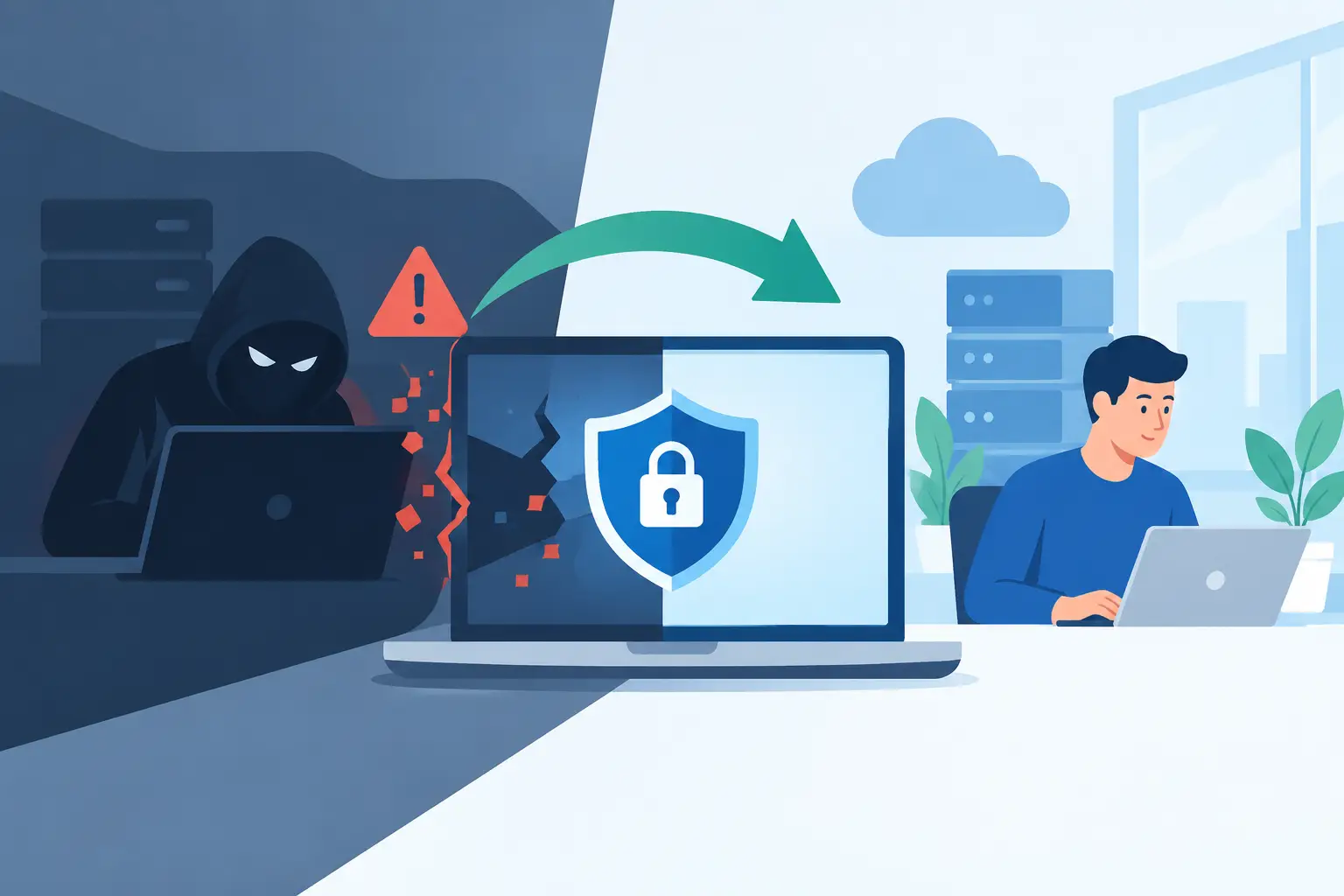
At 2:17 a.m., a security operations team detected an unusual sequence: a valid administrator account authenticated from an unfamiliar device, accessed a file server, and began creating encrypted copies of engineering data. The credentials were real. The activity was not. This breach recovery example shows what separates a disruptive cyber incident from an operational failure: decisive containment, disciplined recovery, and evidence that proves control was restored.
The organization in this scenario is a composite of regulated enterprises with distributed operations, privileged users, sensitive data, and limited tolerance for downtime. Its production environment could not simply be shut down without affecting customers, revenue, and mission delivery. That constraint shaped every decision that followed.
The breach recovery example: the first 30 minutes
The initial alert was not treated as an isolated endpoint event. Analysts correlated identity telemetry, endpoint signals, DNS requests, and file-access behavior. The pattern suggested a compromised privileged account being used to stage ransomware and locate higher-value systems.
The first objective was containment, not investigation for its own sake. Responders revoked active sessions associated with the account, blocked the hostile source indicators, and isolated the affected workstation through the endpoint security integration. They also disabled the account's standing administrative privileges and preserved volatile evidence before the device could be altered or rebooted.
That sequence matters. A compromised identity can remain dangerous even after a suspicious endpoint is isolated. If the attacker has stolen tokens, established additional sessions, created persistence mechanisms, or accessed shared credentials, restoring the original device alone does not remove the threat.
The response team then placed tighter policy controls around adjacent privileged accounts. Access was limited to verified devices, approved network paths, and just-in-time elevation windows. Business-critical operators retained the access required to run essential services, but broad administrative reach was removed until each account and session could be validated.
This is where Zero Trust changes the recovery equation. The goal is not to trust the internal network because an attacker is already inside it. The goal is to verify each request continuously and deny everything that cannot demonstrate legitimate identity, context, and intent.
Containment without stopping the mission
A common failure during breach response is choosing between two bad outcomes: leave systems online too long and risk spread, or take everything offline and create a self-inflicted outage. Mature recovery plans avoid that false choice by identifying which assets must keep operating and what controls can constrain them safely.
In this case, the organization divided its environment into three operational lanes. Systems showing direct indicators of compromise were isolated. Systems connected to those assets received restricted access policies and heightened monitoring. Systems supporting essential operations continued under stricter authentication, network segmentation, and logging requirements.
The trade-off was real. Some employees lost convenient access to shared resources. A few business processes slowed while access paths were reauthorized. But critical operations continued, and the attacker lost the ability to move freely across the environment.
Automated orchestration accelerated those decisions. The security platform blocked known malicious infrastructure, revoked compromised sessions, generated case records, and triggered containment playbooks across identity, endpoint, and network controls. Every action was signed and timestamped, preserving an audit-grade record of what happened, who approved it, and when it changed the environment.
Automation does not replace judgment. It removes delay from repeatable actions while responders focus on the harder questions: Has the attacker reached a domain controller? Were backups accessed? Which identities can still be trusted? What business processes are at risk if a system remains isolated?
Recovery begins with identity, not reimaging
By dawn, the affected workstation had been isolated and the malicious activity had stopped. That was containment, not recovery.
Recovery began with an identity investigation. Responders reviewed authentication histories, administrative group changes, OAuth and service tokens, forwarding rules, remote-access logs, and access to credential stores. They searched for accounts created or modified during the intrusion window, then examined privileged workflows for activity that did not match established behavior.
One service account had been used outside its normal operating pattern. It had not yet been used to encrypt files or deploy malware, but it had accessed systems it did not ordinarily touch. The team rotated its secrets, removed unnecessary permissions, and converted its access to a narrower, policy-controlled model.
This step is frequently underestimated. An organization may rebuild a laptop quickly, yet leave behind the token, service account, API key, or delegated permission that gave the attacker access in the first place. That creates a clean-looking environment with an unclosed door.
The team also reviewed backup integrity before restoration. Backups are only useful when they are isolated from production access, tested for recoverability, and checked for signs of tampering. In this scenario, immutable recovery points were available from before the intrusion window. The organization restored only the affected data sets, rather than rolling back the entire environment and losing a full day of legitimate operational changes.
Restoring systems with proof, not assumptions
The affected endpoint was rebuilt from a known-good image. Required applications and configurations were restored through approved deployment channels, then the device was returned to service under heightened observation. Access was not restored because the clock said the incident was over. It was restored after the endpoint, identity, and network evidence aligned.
That validation included confirming that malware indicators were absent, persistence mechanisms had been removed, credentials and tokens had been rotated, and no unauthorized lateral movement remained. Analysts also performed targeted threat hunts mapped to the techniques observed during the incident, looking for related behavior across endpoints, cloud services, and network segments.
Data classification and data-loss-prevention controls added another critical layer. The team determined what files the compromised account accessed, whether sensitive records were copied externally, and whether encrypted or classified data could have been exposed. Not every breach becomes a reportable disclosure, but that decision must be based on evidence, not optimism.
For a regulated enterprise, recovery has two parallel outcomes. The first is operational: systems, accounts, and data return safely to service. The second is defensible: leadership, customers, auditors, and regulators can see what occurred and how the organization controlled it.
What leadership should take from this breach recovery example
The organization restored essential access within hours because it had already made several hard decisions before the incident. It knew which assets were mission-critical. It had defined who could authorize containment. It had integrated identity, endpoint, network, and data telemetry. It had tested backups and maintained recoverable system baselines.
That preparation did not make the intrusion harmless. It made the response governable.
Executives should expect their recovery plan to answer practical questions before an attacker forces the issue. Which systems can be isolated without stopping operations? Who can revoke privileged access at 3 a.m.? How quickly can the team determine whether an account compromise spread? Can the organization restore a critical workload without reintroducing persistence? Is every response action documented well enough to withstand legal, customer, and regulatory scrutiny?
The answers vary by environment. A hospital, defense contractor, financial institution, and industrial operator will have different availability requirements and escalation paths. But the core discipline is consistent: contain the attacker, reestablish trusted identity, restore from verified sources, and prove that control has returned.
Vulcan Rampart is built for that moment, when a perimeter has failed and the enterprise still has to operate. Continuous verification, automated containment, signed response evidence, and recovery controls turn cyber defense from a collection of tools into a bulwark around the mission.
The measure of recovery is not whether a device comes back online. It is whether the organization can return to work knowing the attacker no longer has a path back in.