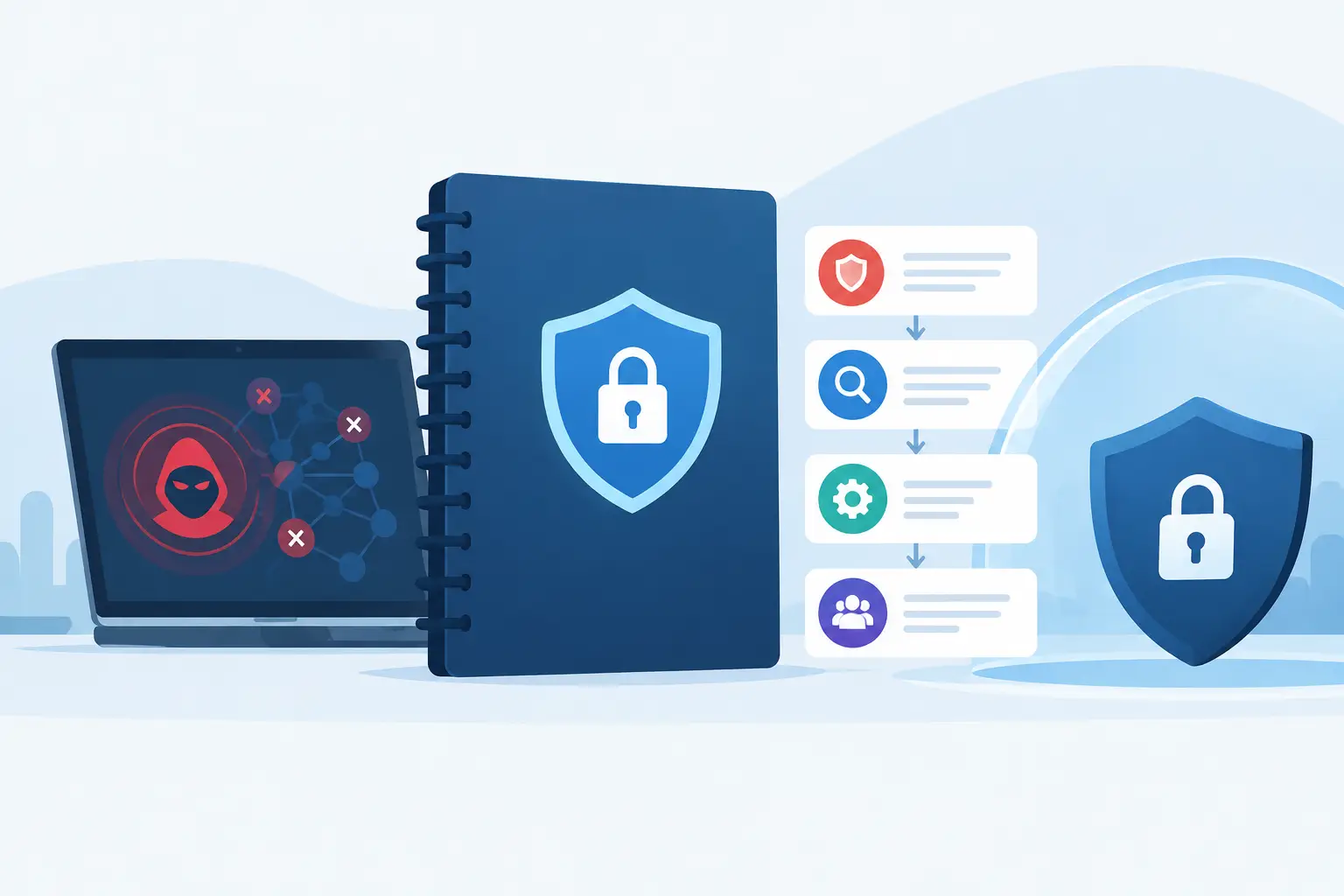
A containment decision made 20 minutes too late can turn one compromised account into an enterprise outage. The organizations best positioned to withstand that pressure create cyber containment playbooks before an attacker reaches a privileged system, production environment, or sensitive data store. The goal is not paperwork for its own sake. It is decisive, authorized action that stops spread while preserving the business functions that must continue.
A useful playbook answers the questions a security team cannot afford to debate during an active incident: What happened? Who can authorize containment? Which controls act first? What operational impact is acceptable? How will the organization prove what it did and why?
What Cyber Containment Playbooks Must Accomplish
Containment is the phase where an organization limits an adversary's ability to move, persist, escalate privilege, encrypt data, exfiltrate information, or disrupt operations. It sits between detection and recovery, but it cannot be treated as a generic middle step. Containing a stolen executive credential requires a different response than containing ransomware in a manufacturing segment or suspected insider data theft.
The strongest playbooks are built around business consequences, not only alert categories. A high-confidence malware alert on a developer laptop may support immediate endpoint isolation. The same action against an engineering workstation controlling an operational process may create unacceptable safety or availability risk. In that case, the playbook may require network microsegmentation, removal of remote access, and a controlled handoff to operations before the endpoint is isolated.
Every playbook should establish four outcomes: halt attacker movement, protect the assets that matter most, retain evidence for investigation and reporting, and preserve essential operations wherever possible. These goals can conflict. A full network shutdown may stop an intrusion, but it can also stop revenue, patient care, public services, or industrial output. Effective containment is controlled force, not indiscriminate force.
Start With the Assets That Cannot Fail
A playbook cannot protect everything with equal urgency. Begin by identifying crown-jewel assets and the dependencies that support them. These commonly include privileged identity systems, production applications, customer and regulated data, financial platforms, OT environments, cloud control planes, backup infrastructure, and third-party connections.
For each asset group, document the business owner, technical owner, normal access paths, critical dependencies, approved maintenance windows, and maximum tolerable disruption. Then define the containment actions that are safe to automate and those that require human approval.
This distinction matters. Revoking an active cloud session for a compromised user is often low-risk and should happen in seconds. Disabling a shared service account that supports a production application may require an alternate credential, application owner confirmation, or a staged cutover. The playbook should make that decision path explicit before the incident begins.
Build Playbooks Around Real Attack Paths
Alert names are not playbooks. “Malware detected” tells responders very little about the attacker’s access, intent, or reach. Build scenarios around the attack paths most likely to threaten your organization.
For most enterprises, the priority set should cover compromised credentials, privileged-account misuse, ransomware or destructive activity, suspected data exfiltration, insider-threat activity, cloud control-plane compromise, and vendor or remote-access intrusion. These scenarios map to how attackers actually move through identity, endpoint, network, data, and cloud layers.
Compromised Identity and Privileged Access
A compromised identity playbook should begin with confidence scoring. Was the login impossible travel, password spraying, token theft, MFA fatigue, or confirmed adversary activity? When confidence crosses the defined threshold, revoke sessions, disable or restrict the account, remove active tokens, block suspicious source infrastructure, and inspect recent privilege changes.
For privileged accounts, require a more forceful branch. Disable just-in-time elevation, rotate affected credentials, identify newly created accounts or role assignments, and review authentication activity across connected systems. The objective is to prevent the attacker from using one credential to establish durable control.
Ransomware and Lateral Movement
Ransomware containment must move at machine speed once indicators are validated. Isolate affected endpoints from east-west traffic, block command-and-control infrastructure, restrict administrative shares, and protect backup repositories from the compromised identity domain. Hunt for the same indicators across endpoint, network, and identity telemetry rather than waiting for encryption to appear elsewhere.
But isolation needs context. A blanket action can sever remote sites or critical devices from required services. Define segmented containment options in advance: isolate one host, quarantine a VLAN, deny administrative protocols, disable remote management, or place a site into a restricted operations mode. The right choice depends on the scope, confidence, and operational dependency.
Data Exfiltration and Insider Activity
Data theft often requires a different posture than ransomware. The attacker may still have access, and abrupt action can cause them to destroy evidence or accelerate exfiltration. A playbook should support both covert and overt containment.
Covert measures can tighten access policies, increase logging, restrict unsanctioned cloud storage, flag unusual bulk downloads, and require step-up authentication. Overt measures may suspend accounts, revoke sessions, preserve mailbox and endpoint evidence, and involve legal, HR, privacy, or executive leadership. The authorization model must account for the fact that insider incidents can carry employment, contractual, and regulatory consequences.
Define Triggers, Authority, and Time Limits
A playbook fails when responders must seek approvals from people who are unavailable or unclear on their authority. Define severity thresholds and pre-authorized actions for each scenario. A high-confidence detection from multiple sources may automatically trigger containment. A low-confidence anomaly may require analyst review within a stated service level.
For every action, identify the incident commander, technical executor, business owner, and escalation authority. Include a 24/7 contact method and an alternate decision-maker. During a crisis, a role is more reliable than a name alone, but both are necessary.
Containment also needs expiration conditions. Temporary blocks, emergency access restrictions, and endpoint quarantines should not remain indefinitely because no one owns reversal. Specify who validates the action, what evidence supports restoration, and how the organization confirms that the attacker no longer has a path back in.
Automate the First Moves, Not Every Move
Speed matters, which makes SOAR automation valuable. It can block known hostile IPs, revoke sessions, isolate endpoints, open incident records, collect volatile evidence, enrich indicators, and notify the right teams in seconds. These are repeatable actions where delay benefits the attacker.
Automation should be governed by confidence and blast radius. An action that affects a single device can have a lower approval threshold than one that disables a production identity provider or blocks a business-critical third-party integration. High-impact actions should include a human approval gate unless the organization has tested the failure mode and explicitly accepts the operational trade-off.
Vulcan Rampart applies this model through policy-enforced Zero Trust controls and SOAR-driven response actions that can contain hostile activity across identity, endpoint, network, and data layers while producing signed, timestamped evidence.
Preserve Evidence While You Contain
Containment without evidence creates a second problem. Investigators need to understand initial access, scope, persistence, impacted data, and whether the adversary was fully removed. Regulators, customers, insurers, and leadership may also require an auditable account of what occurred.
Build evidence collection into the playbook. Preserve relevant logs, endpoint telemetry, authentication records, cloud audit events, network flows, memory captures where appropriate, and copies of malicious files or communications. Record every containment action, the person or system that initiated it, the timestamp, the reason, and the result.
Evidence preservation must be practical. Do not delay urgent isolation while waiting for a perfect forensic image. Capture what is feasible, isolate the threat, and use protected logging and snapshots to support the investigation. The order of operations should reflect the immediate risk to mission assets.
Test Playbooks Against Operational Reality
A playbook that has not been tested is an assumption. Run tabletop exercises with security, IT, operations, legal, communications, and executive stakeholders. Then conduct technical simulations that validate whether the stated actions work across actual tools, networks, identity systems, and cloud environments.
Measure time to validate, time to contain, percentage of actions completed automatically, evidence completeness, and business disruption caused by the response. Review failures without blame. If a playbook depends on an outdated asset inventory, a missing contact, or a tool integration that cannot execute the required action, fix the operating model before the next incident exposes it.
The standard is simple: when an attacker gains ground, your organization should not be writing its response in real time. Build the authority, telemetry, controls, and tested decisions now, so containment becomes a disciplined act of defense and the mission keeps moving.