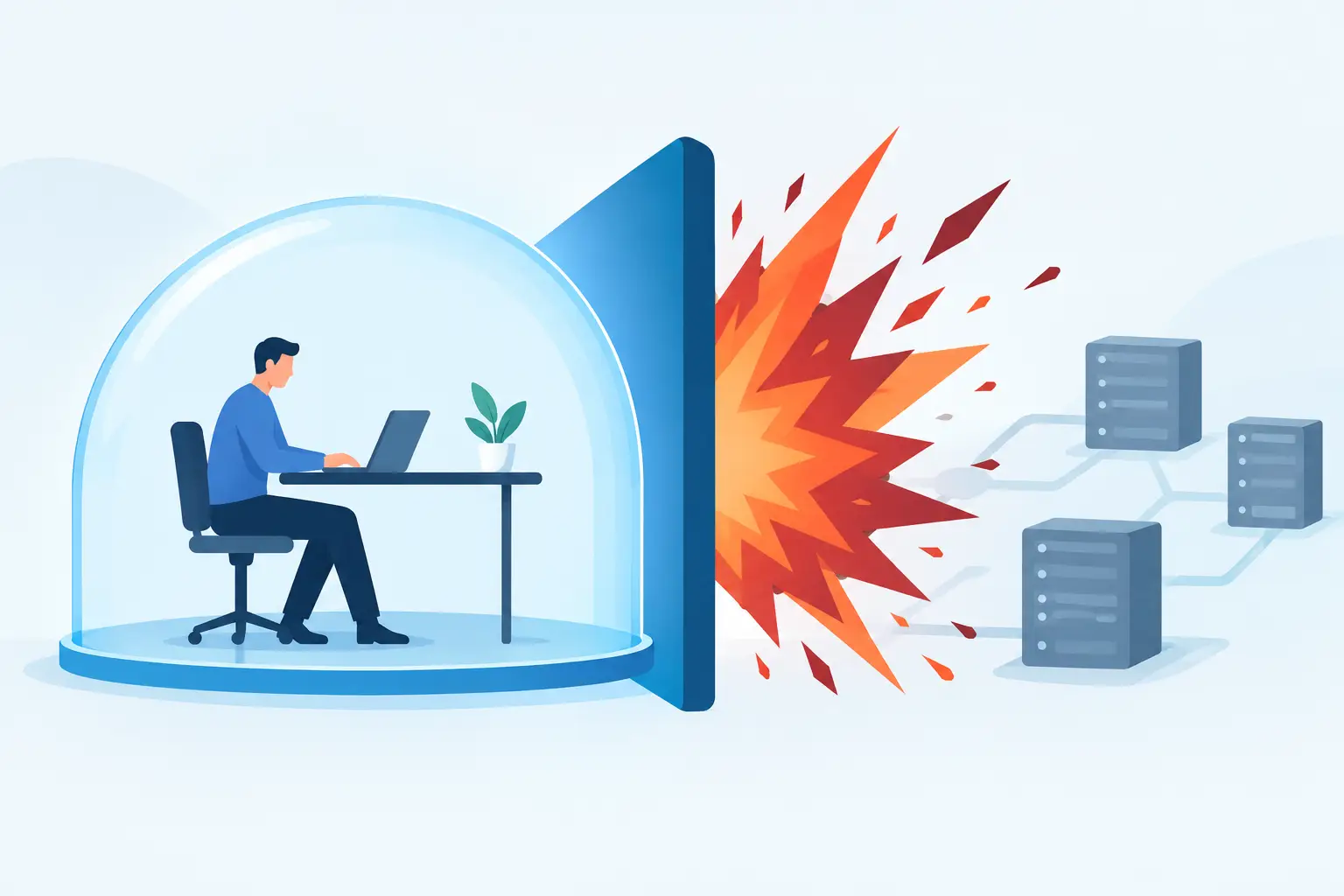
A credible insider containment example does not begin with a dramatic accusation. It begins with a signal that a trusted identity is behaving outside its approved purpose: an engineer exporting controlled files at 2 a.m., a departing employee querying customer records, or a privileged administrator creating access paths that no change ticket authorized. The first operational question is not who to blame. It is how to stop the blast radius without stopping the mission.
For security and operations leaders, that distinction matters. An insider incident may involve malice, negligence, credential compromise, or a contractor operating far beyond the access required for the job. The visible activity can look similar. A rushed response that shuts down an entire environment can inflict the same operational damage an attacker intended. A delayed response can give the actor time to move data, alter systems, or erase evidence.
Containment must be fast, targeted, defensible, and reversible where possible. That is the line a mature Zero Trust program holds.
An Insider Containment Example in a Production Environment
Consider a manufacturer with a regulated engineering environment, a corporate network, and connected production systems. A senior design engineer submits notice of resignation. Two days later, behavior analytics identifies an unusual sequence: the engineer authenticates from a managed laptop, accesses a design repository never used in their normal workflow, compresses a large group of files, and attempts to upload the archive to an unsanctioned cloud storage service.
None of these actions alone proves intent. Engineers occasionally need access outside a routine project path. Large transfers may be legitimate. But the combination of off-pattern repository access, bulk collection, archive creation, and an unapproved destination creates a high-confidence risk signal. The risk increases because the identity has access to intellectual property that affects future revenue and contractual obligations.
The security operations team should not wait for a manager to review the activity the next morning. Nor should it pull the plug on the entire engineering network. The proper containment objective is narrower: stop the suspected path of exfiltration, preserve the facts, maintain essential work, and prevent the identity from establishing another route.
The First Minutes: Contain the Identity, Not the Business
A policy-driven response begins by revoking active sessions associated with the user and blocking the attempted cloud destination. The account is placed into a restricted access state rather than simply deleted. That distinction preserves the ability to investigate while denying access to sensitive repositories, remote administration tools, and data-transfer channels.
The endpoint is then isolated from external communications through the endpoint security platform, while retaining a managed connection for collection and response. If the device supports a production process or contains active work needed by others, responders can preserve local availability while preventing lateral movement, command-and-control traffic, and additional uploads.
At the same time, the policy engine evaluates every related access decision. Any just-in-time privileged elevation is terminated. API tokens, temporary credentials, virtual private network sessions, and federated application sessions tied to the identity are revoked. Conditional access rules prevent sign-in from unmanaged devices, unfamiliar locations, or newly enrolled mobile devices.
This is where Zero Trust changes the outcome. Traditional containment often depends on network segmentation alone: disconnect a workstation, block an IP address, disable an account. Those actions remain useful, but they do not reliably address cloud sessions, standing privileges, shared credentials, service accounts, or data already moving through approved channels. Continuous verification gives defenders more precise controls over identity, device health, application access, and data movement.
Preserve Evidence Before It Disappears
Containment without evidence preservation creates a second failure. The organization may stop the immediate activity yet lose the information needed to determine what was accessed, whether data left the environment, who else was involved, and what must be disclosed under contract or regulation.
In this scenario, the response team captures endpoint telemetry, process history, browser artifacts, authentication logs, repository audit records, data-loss-prevention events, DNS requests, proxy activity, and cloud audit trails. The engineering repository is placed under enhanced monitoring, and logs from systems touched by the account are retained under legal and incident-response procedures.
Every containment action should be signed, timestamped, and tied to the trigger that justified it. This record protects the organization in several directions. It helps investigators reconstruct the event. It gives leadership a factual basis for employment and legal decisions. It provides auditors and regulators evidence that the company acted decisively and proportionately.
The trade-off is real. Collecting evidence takes discipline, and a poorly designed response can alter the very system state investigators need to examine. That is why automated playbooks should perform only preapproved actions, with clear escalation points for human judgment. Automation should accelerate response, not replace accountable decision-making.
Investigate the Scope, Not Just the Alert
The attempted upload may be the end of the story, or it may be one step in a longer campaign. Investigators need to determine whether the account was used elsewhere, whether the user accessed other sensitive assets, and whether another identity or device enabled the activity.
A focused scope assessment asks several questions: Which repositories, shares, applications, and records did the identity access? Were files merely viewed, downloaded, copied, compressed, encrypted, or transmitted? Did the user create new credentials, mailbox rules, remote-access paths, or application integrations? Did the endpoint communicate with internal systems it does not normally reach? Are there matching behaviors from peers, contractors, or service accounts?
Behavior analytics can identify deviations from the user’s established pattern, but context matters. A late-night file transfer from a finance director may be justified during an acquisition. The same transfer to a personal storage account, immediately after a resignation notice and from an unmanaged device, demands a different response. The goal is not to turn every anomaly into an accusation. The goal is to make high-risk activity unable to proceed unchecked.
Restore Only the Access the Mission Requires
Once the immediate risk is contained, operations leaders face a practical problem: the engineer may own active designs, workflows, or approvals required for a customer commitment. An indiscriminate lockout can delay production, breach a contract, or create a safety concern.
The answer is not to restore the original access and hope for the best. It is to reconstitute necessary access under tighter control. A manager and asset owner can identify the specific projects that require continuity. Access can be granted to another verified employee through role-based and attribute-based policy, with time-bound elevation, monitored sessions, and restrictions on export or external sharing.
For the subject of the investigation, any legitimate business access should be minimal, supervised, and limited to approved systems. In some cases, HR, legal counsel, and security leadership may decide that no access is appropriate. In others, a controlled transition period may be necessary. It depends on the person’s role, the nature of the evidence, contractual requirements, and the operational consequences of removal.
This controlled restoration is often overlooked. Recovery is not simply returning systems to normal. Recovery means returning the organization to a trusted operating state.
What This Insider Containment Example Reveals
The strongest containment programs are built before an employee gives notice, a contractor changes roles, or a privileged credential is stolen. They establish which data matters most, who should reach it, what normal behavior looks like, and which actions trigger immediate controls.
Four capabilities make the difference under pressure:
- Continuous identity, endpoint, network, and data monitoring that identifies suspicious combinations of activity rather than isolated events.
- Fine-grained policy enforcement that can restrict sessions, privileges, devices, and transfer paths without shutting down whole business units.
- Automated containment playbooks that revoke access and preserve evidence in minutes, with human escalation for consequential decisions.
- Audit-grade records that demonstrate what happened, what was protected, and why each response action was taken.
Vulcan Rampart applies this model from the inside out: verify every request, narrow access to the mission need, and execute containment actions before a single compromised or misused identity becomes an enterprise-wide event.
The Standard Is Operational Continuity
Insider containment is not a test of how quickly an organization can disable an account. It is a test of whether security can deny a dangerous action while the business continues to operate under control. The best response protects sensitive data, preserves evidence, and keeps essential systems moving without granting trust on assumption.
When the next anomalous action appears, the organization should not have to invent its response in the incident bridge. The policy, authority, evidence path, and recovery plan should already be standing watch. Perimeters break. Trusted access can be abused. The rampart holds when containment is ready before the alert arrives.