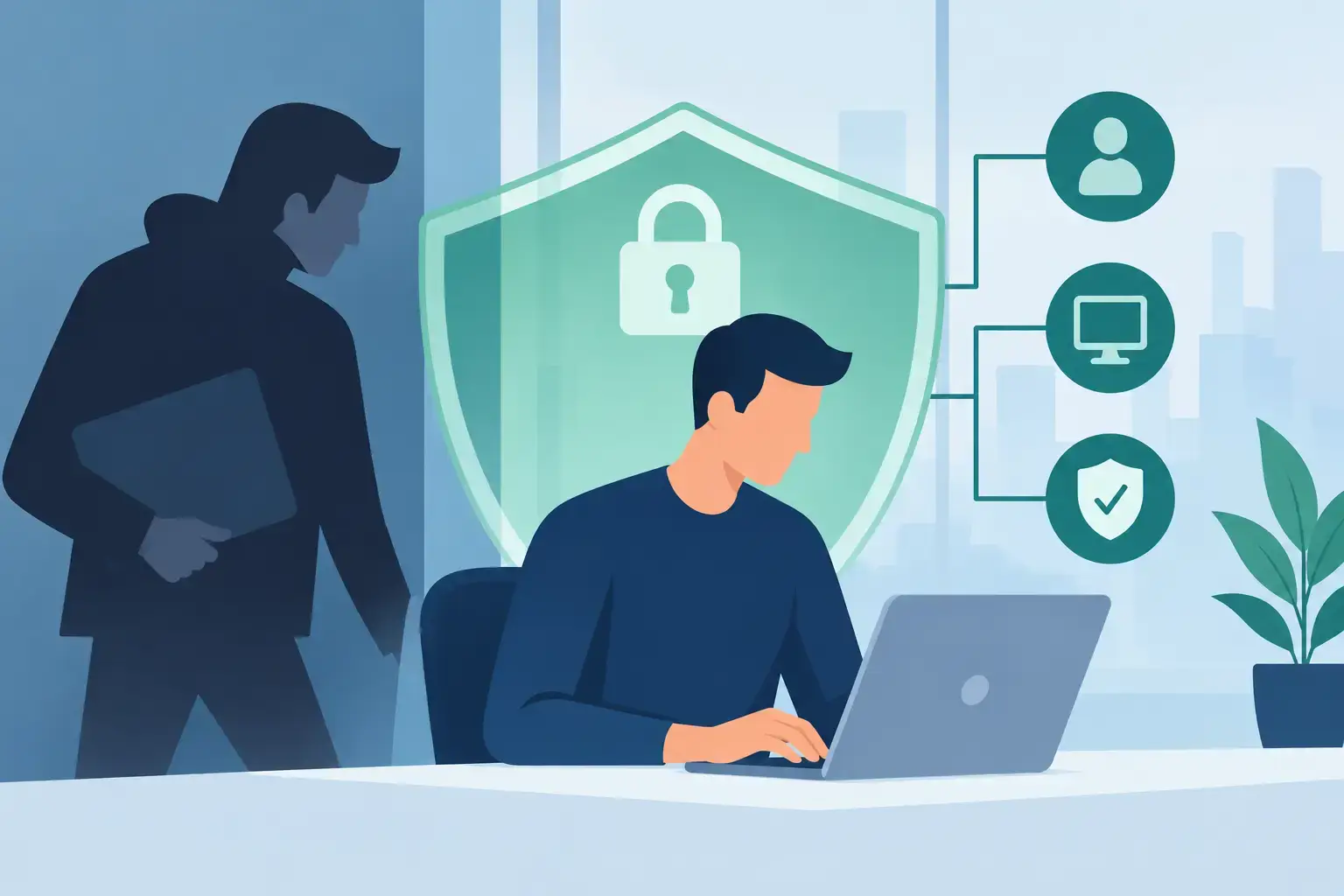
A privileged administrator exports a customer database before resigning. A finance employee approves a fraudulent payment after an account takeover. An engineer uploads controlled design files to an unapproved AI tool to meet a deadline. Insider threats do not always begin with malicious intent, but they all begin from a position the organization has already trusted.
That is what makes them operationally dangerous. The actor may understand the environment, know where critical data resides, possess valid credentials, and move without triggering the signals associated with an outside intrusion. For security leaders, the question is not whether employees, contractors, and service accounts should be trusted. The question is how much access they should retain, under what conditions, and how quickly that access can be contained when behavior changes.
Why insider threats defeat perimeter-first security
A perimeter can stop some attacks before they enter. It cannot govern what a valid user can do after access is granted. Once a user is authenticated, traditional security models often assume that the session is legitimate and that activity inside approved network boundaries is acceptable.
That assumption creates room for damage. A malicious insider may steal intellectual property, sabotage production systems, or misuse privileged credentials. A negligent insider may mishandle regulated data, reuse passwords, or bypass policy with shadow IT. A compromised insider is a legitimate user whose account, device, token, or session has been taken over by an external attacker.
The outcome can look the same: sensitive data leaves the organization, a critical process is disrupted, or an attacker gains persistence through an account that should have been trusted. Intent matters for investigation and personnel action. It does not change the immediate security requirement: stop unauthorized behavior without shutting down the mission.
For organizations supporting regulated workloads, critical infrastructure, defense programs, or revenue-critical operations, that distinction is decisive. The incident is not merely an HR problem or a compliance exception. It is a continuity event.
The warning signs are often behavioral, not binary
Most insider activity does not announce itself with malware or a failed login storm. It appears as a deviation from normal work patterns. A user who routinely accesses one application suddenly queries large volumes of data. A contractor whose assignment ended weeks ago attempts to reach a production segment. A service account begins authenticating from a new location at unusual hours.
No single signal proves malicious activity. Employees may work late during a release, access unfamiliar systems during an emergency, or transfer large files for a valid business purpose. Security teams that treat every anomaly as proof will create alert fatigue and damage trust with the workforce.
The stronger approach is contextual. Identity, device posture, location, data sensitivity, requested action, peer-group behavior, and prior activity should be evaluated together. User and entity behavior analytics can identify meaningful deviations, while endpoint, network, and identity telemetry helps determine whether the deviation is risky, benign, or evidence of compromise.
This is where monitoring has to support decisions, not simply produce more dashboards. Leaders need answers fast: What asset is at risk? Which account is involved? What access paths exist? Has data already moved? Can the session be revoked without interrupting unrelated operations?
Zero Trust limits the damage a trusted identity can cause
Zero Trust is often described as a replacement for trust. In practice, it is a disciplined way to make trust conditional, narrow, and continuously verified. A user does not receive broad access because they passed a login screen in the morning. Each request is evaluated against identity, role, device health, location, risk signals, and the sensitivity of the target resource.
That changes the insider-threat equation. Role-based access control establishes a baseline for what a person should access. Attribute-based controls add context, such as project assignment, clearance, device state, or time-bound authorization. Just-in-time elevation gives administrators the rights required for a specific task and removes them when the task is complete.
The default stance should be deny. Access is earned for a defined purpose, then reevaluated as conditions change. If a device falls out of compliance, a session behaves abnormally, or a user attempts to reach data outside their operational need, the policy engine should be able to challenge, restrict, or block the request.
This is not a call to make every employee fight through security prompts all day. Overly rigid controls can slow production, encourage workarounds, and reduce the value of security itself. The objective is precision: apply friction where risk rises, preserve efficient access where context supports it, and make exceptions visible, approved, and temporary.
Build detection around the assets that keep the mission moving
An insider-threat program fails when it starts with generic surveillance and ends with a stack of unreviewed alerts. Begin with the assets whose compromise would create material harm: privileged accounts, production systems, source code, operational technology, payment workflows, regulated records, customer data, and administrative control planes.
Then identify who can reach those assets, through which applications and devices, and with what level of privilege. Many organizations discover that access accumulated over years of role changes, acquisitions, emergency exceptions, and third-party onboarding. The account is active, the entitlement is technically valid, and no one can clearly explain why it remains.
Data inventory and classification are central to this effort. An organization cannot meaningfully prevent exfiltration if it does not know where sensitive data lives or which copies have been created. Data loss prevention, field-level encryption, and policies that travel with the data can reduce exposure across cloud environments, endpoints, collaboration platforms, and unmanaged sharing paths.
AI introduces another path that requires specific attention. Employees may paste source code, contract language, incident details, or customer records into generative AI tools without recognizing the retention or disclosure risk. Rogue-AI detection and clear policy controls help distinguish approved business use from unsafe data handling, while preserving legitimate innovation.
Containment must be measured in minutes
When suspicious insider activity crosses the threshold from concern to incident, the first objective is containment. Investigation matters, but it cannot come at the cost of continued access to critical systems or continued data loss.
The response should be proportionate to the risk. For a suspected compromised session, revoke tokens, force reauthentication, and isolate the affected endpoint. For unauthorized privilege use, remove elevation and restrict access to the targeted system. For active exfiltration, block the transfer path, preserve relevant evidence, and determine whether additional accounts or devices are involved.
Automation is valuable when it executes preapproved actions at machine speed. A SOAR workflow can block hostile infrastructure, disable risky sessions, open an incident record, collect forensic telemetry, and coordinate actions across identity, endpoint, and network tools. Every action should be timestamped and preserved as signed evidence, especially where regulators, auditors, legal teams, or government customers will require a defensible record.
Automation does not eliminate judgment. A production operator may have a legitimate reason to access a sensitive environment during an outage. A poorly designed auto-block could worsen the event it intends to contain. The right model is to automate known, high-confidence actions and escalate ambiguous, high-impact decisions to responders who understand the operational context.
Recovery is part of insider-threat defense
Containment alone does not restore confidence. After access is restricted, teams must determine what changed, what data was accessed, which credentials may remain exposed, and whether the incident altered systems or business records. Recovery may involve credential rotation, account rebuilds, endpoint remediation, permission cleanup, data restoration, and targeted validation of production integrity.
This is also the moment to correct the control gap without turning the event into a blame exercise. If a departing employee retained access too long, strengthen offboarding and entitlement reviews. If an administrator needed standing privilege to do routine work, redesign the workflow around just-in-time access. If a user bypassed a policy to meet a deadline, examine whether approved tools and processes actually support the mission.
Vulcan Rampart approaches this work from the inside out: continuous verification, layered visibility, rapid containment, and recovery evidence that stands up to scrutiny. The goal is not to watch employees more aggressively. It is to defend mission assets when trust, credentials, or normal business activity are used against the organization.
The strongest insider-threat posture gives people the access they need and no more, detects meaningful changes before they become losses, and preserves the ability to act decisively when the line is tested. Start with the accounts and assets that would hurt most to lose, then make every path to them prove its purpose.