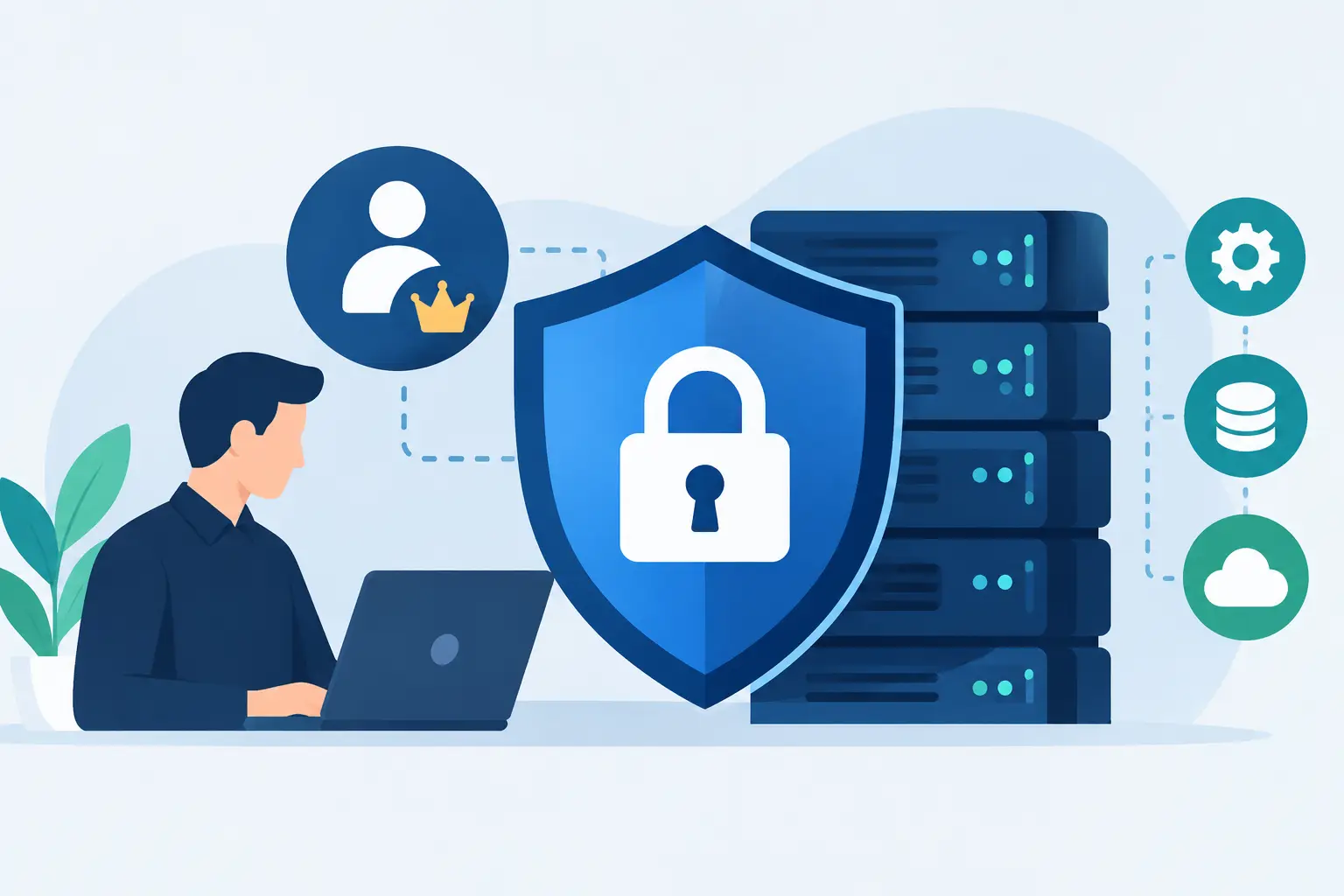
A service account that can reset production credentials, deploy code, query customer records, or administer an industrial controller is not a background technical detail. It is a standing privileged pathway into the mission. To secure privileged service accounts, organizations must treat them as high-value identities with defined owners, narrowly granted authority, continuously verified access, and an immediate containment path.
These accounts are built for machines, applications, services, and automation. That purpose makes them essential. It also makes them attractive to attackers. A compromised employee account may have limits. A compromised service account often has persistent access, broad permissions, weak monitoring, and credentials that have not changed in years. The result is a quiet route around controls designed for human users.
Why Service Accounts Become a Breach Multiplier
Most enterprises do not set out to create unmanaged privilege. It accumulates through operational necessity. An application needs to read a database. A backup tool needs access across servers. A deployment pipeline needs to push changes. An integration needs an API token. Each request may be defensible on its own. Over time, however, organizations inherit service accounts no one can confidently explain, permissions no one can safely remove, and secrets embedded where no one routinely looks.
Attackers understand that this is where access outlives personnel changes, password rotations, and periodic reviews. They hunt for credentials in source repositories, deployment scripts, configuration files, cloud metadata, endpoint logs, and automation platforms. They also abuse identity paths: OAuth consent, service principals, federation trust, token theft, and compromised CI/CD runners.
The danger is not simply unauthorized sign-in. A privileged nonhuman identity can give an adversary the ability to move laterally, alter security tooling, exfiltrate regulated data, encrypt systems, or persist after the initial intrusion is contained. In operational technology and critical infrastructure environments, an overprivileged service account can also threaten availability and safety. The business consequence is immediate: interrupted operations, delayed recovery, compliance exposure, and an audit trail too thin to establish what happened.
Secure Privileged Service Accounts With Identity-First Controls
The right goal is not to remove every service account. Modern operations depend on them. The goal is to make every privileged machine identity intentional, constrained, observable, and recoverable.
Start with an authoritative inventory
You cannot defend identities you cannot see. Build a complete inventory across on-premises Active Directory, cloud identity providers, SaaS platforms, Kubernetes clusters, databases, CI/CD systems, network devices, security tools, and OT management infrastructure. Include service accounts, service principals, API keys, certificates, managed identities, application tokens, and nonhuman accounts created by vendors.
For each identity, record its business purpose, system owner, technical owner, creation date, authentication method, privilege level, connected applications, environments, secret location, and last successful use. The key question is direct: if this identity were disabled today, who would know why operations failed and who could restore it safely?
Accounts without accountable owners should be treated as a risk condition, not an administrative inconvenience. Dormant accounts should be disabled after validation. Shared accounts should be retired or separated wherever possible. A useful inventory is living evidence, not a spreadsheet prepared for an audit.
Replace standing privilege with scoped access
Service accounts should receive only the access required for a defined task, on a defined system, under defined conditions. This is least privilege in practice, enforced with role-based and attribute-based policy rather than broad group membership that persists indefinitely.
Do not grant domain administrator, tenant administrator, or unrestricted database roles because an integration might need elevated access someday. Separate functions by environment and workload. A development pipeline should not hold production authority. A backup account should not manage endpoint security. An application identity that reads records should not be able to delete them.
Where the platform permits it, use just-in-time elevation for nonhuman workflows. This is especially valuable for deployment, maintenance, break-glass automation, and administrative jobs that need elevated permission briefly. The trade-off is engineering effort: legacy applications may not support short-lived credentials or dynamic authorization without redesign. That is not a reason to accept permanent privilege. It is a reason to prioritize the highest-risk accounts first and establish compensating controls while modernization proceeds.
Eliminate static secrets wherever possible
Hard-coded passwords and long-lived API keys are a predictable point of failure. They travel into repositories, tickets, chat transcripts, backup archives, and administrator workstations. Rotating a secret that is embedded in a fragile production application can also create downtime, which is why teams often postpone it. Attackers count on that delay.
Prefer managed identities, workload identity federation, short-lived tokens, certificate-based authentication, and tightly governed secrets vaults. Secrets should be issued to an authenticated workload, not copied freely between systems. Rotation must be automated, tested, and tied to a documented recovery procedure.
For service accounts that still require passwords, apply strong generation, secure storage, frequent rotation based on risk, and access restrictions that prevent interactive logon unless it is explicitly required. Post-Quantum Cryptography-hardened authentication and modern phishing-resistant factors matter most for the human administrators who can create, modify, or impersonate these identities.
Verify Every Request, Not Just the Login
A valid credential is not proof of legitimate intent. Zero Trust changes the control point from a one-time login decision to continuous verification of the identity, device, workload, network path, behavior, and requested action.
For privileged service accounts, policy should evaluate whether the request is coming from the expected workload, in the expected environment, using the expected protocol, at an expected time, and against an approved target. A deployment service connecting to its assigned production cluster during a release window is different from the same identity attempting to enumerate file shares at 2:00 a.m.
Conditional access must be designed carefully. Controls that are too rigid can interrupt automation that keeps the enterprise running. Controls that are too broad become security theater. The answer is not a blanket bypass. It is a policy model based on known service behavior, staged validation, and exception windows that expire automatically.
Detect Misuse Before It Becomes Persistence
Privileged service-account security fails when visibility stops at authentication logs. Detection must correlate identity activity with endpoint, network, cloud, application, and data events. Security leaders need to know not only that a service account authenticated, but what it accessed, what it changed, where it connected, and whether the behavior matches its assigned purpose.
High-value detections include unexpected interactive logons, access from an unapproved host, new token creation, changes to privileged group membership, abnormal API volume, use outside maintenance windows, disabled logging, secret retrieval spikes, and access to systems unrelated to the account's function. UEBA can identify deviations that a static rule misses, particularly when attackers use legitimate credentials and standard management tools.
Detection must lead to action. When a privileged workload identity shows signs of compromise, the response path should be able to revoke sessions, disable or quarantine the identity, rotate associated secrets, isolate the host or runner, block hostile network indicators, and preserve signed evidence. Speed matters because attackers use privileged access to establish secondary paths before defenders complete a manual investigation.
Build Recovery Into the Account Design
Every control introduces an operational question: what happens when the identity is unavailable? A secure design accounts for that before an incident, not during one. Define emergency access procedures, approve break-glass identities sparingly, protect them with stronger controls, and test them under realistic outage conditions.
Recovery plans should identify dependent applications, alternate authentication methods, secret restoration processes, privileged access approvers, and the evidence required to prove restoration was controlled. In regulated environments, recovery without audit-grade records can create a second crisis after the technical incident is over.
Vulcan Rampart applies this discipline through policy-enforced Zero Trust, continuous identity and behavior monitoring, automated containment, and signed response evidence. The objective is clear: contain a compromised privileged pathway in minutes while preserving the ability to restore mission systems with confidence.
Make Ownership a Security Control
Technology cannot compensate for an account that belongs to everyone and no one. Service-account governance needs a regular operating rhythm: owners attest to purpose and access, technical teams validate dependencies, security teams review risk signals, and leadership receives visibility into exceptions that carry material exposure.
The strongest program is measured by more than the number of accounts discovered or passwords rotated. Measure how many privileged identities have named owners, how many use short-lived credentials, how many retain standing administrative access, how quickly anomalous activity is contained, and whether recovery procedures work when production pressure is real.
The next privileged service account created in your environment should arrive with an owner, a narrow purpose, an expiration or review date, monitored behavior, and a tested containment plan. That is how an indispensable operational identity becomes a defended asset rather than the route an attacker uses to cross the line.