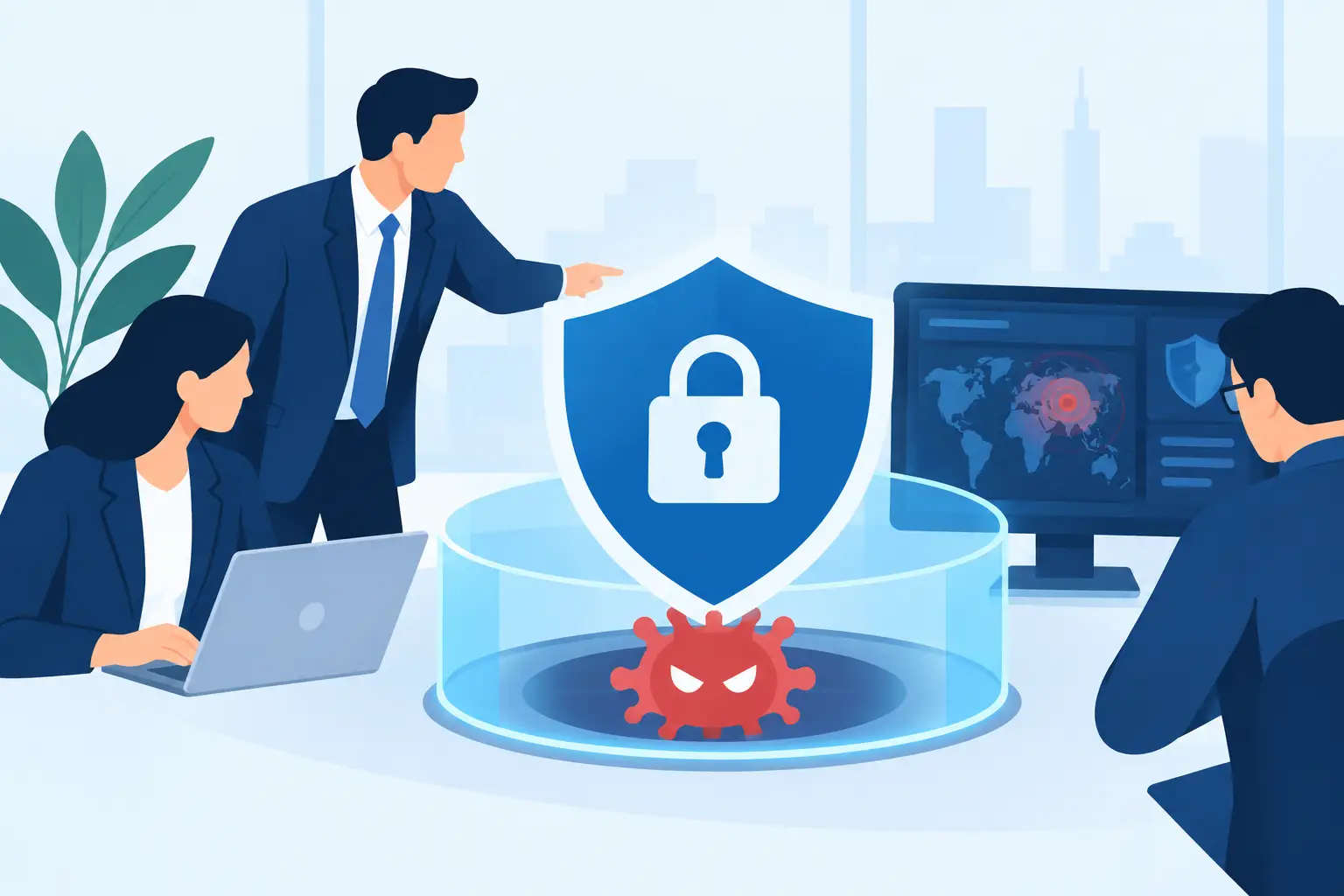
A security incident containment guide is not a document you open after an attacker has already spread. It is the operating discipline that determines whether a compromised account becomes a contained event or a business-stopping breach. When privileged access, production systems, sensitive data, or operational technology are under pressure, the mandate is direct: stop the adversary's movement without stopping the mission unnecessarily.
Containment is a leadership decision as much as a technical one. Security teams need authority, visibility, and preapproved actions before the alert arrives. Operations leaders need to know which systems can be isolated, which must remain available for safety or continuity, and who can make that call at 2:00 a.m. The organization that settles those questions during an incident is already behind the attacker.
What Containment Is Designed to Do
Containment limits an adversary's options. It breaks the paths used to escalate privilege, move laterally, exfiltrate data, deploy ransomware, or sabotage operations. It does not mean pulling every cable, shutting down every workload, or treating every alert as a full enterprise compromise.
The correct response depends on the asset, the threat behavior, and the confidence of the evidence. A compromised employee laptop may require immediate network isolation. A privileged cloud account may require instant session revocation, credential reset, and review of every action performed under that identity. A suspected intrusion in a manufacturing environment may require segmentation and heightened monitoring rather than an abrupt shutdown that creates a safety risk.
Speed matters, but uncontrolled speed creates its own damage. The objective is decisive, proportionate action: contain the threat, preserve the evidence, and maintain the services the business cannot afford to lose.
Security Incident Containment Guide: Set Authority First
The first minutes of an incident should not be consumed by finding someone who can approve a block, isolate an endpoint, or disable a senior executive's account. Define incident authority in advance. The incident commander needs clear authority to direct response, while security, IT, legal, operations, communications, and executive leadership understand their responsibilities.
For high-impact incidents, establish thresholds that trigger predefined actions. For example, confirmed credential theft involving an administrator should automatically revoke active sessions and suspend privileged access. Confirmed ransomware behavior should isolate affected endpoints, restrict file-share access where necessary, and protect backup infrastructure. Suspicious activity alone may warrant increased telemetry and targeted restrictions while analysts validate scope.
This is where business context separates a mature containment program from a generic playbook. A domain controller, a payment environment, a production scheduler, and an executive mailbox do not carry the same operational consequences. Rank mission assets, identify their owners, document dependency paths, and define the containment options that are acceptable for each. If the organization cannot identify its critical assets during an event, it cannot defend them with precision.
Contain Identity Before the Attacker Expands
Most sophisticated incidents become enterprise incidents through identity. Attackers do not need to break every endpoint when they can reuse valid credentials, harvest browser tokens, abuse remote administration tools, or gain standing access through a cloud identity.
Treat a suspected identity compromise as an active control failure, not simply a password-reset ticket. Revoke sessions and refresh tokens. Disable or constrain the account based on the risk. Remove unauthorized authentication methods, review mailbox rules and delegated permissions, rotate exposed secrets, and validate privileged group membership. If an attacker accessed a service account, examine where that account can authenticate and what it can reach.
A Zero Trust model makes this work faster because access is continuously evaluated rather than assumed valid after login. Context matters: device health, location, authentication strength, behavior, requested resource, and privilege level should all affect the policy decision. Just-in-time elevation narrows the window in which a stolen privilege can be used. Role-based and attribute-based controls reduce the blast radius when one identity fails.
There is a trade-off. Broad account disablement may disrupt critical teams, customers, or field operations. Leaving access intact may give an attacker time to establish persistence. Use risk-based restrictions when the evidence is incomplete, but do not allow concern over inconvenience to delay action on a confirmed compromise.
Isolate Systems Without Destroying Evidence
Endpoint and network containment should be targeted, fast, and reversible when possible. Isolate a device from untrusted networks while retaining a controlled management path for investigation. Block malicious domains, IP addresses, hashes, and command-and-control patterns across the relevant enforcement points. Segment affected workloads from sensitive systems and restrict east-west traffic that the attacker could use to move.
Before reimaging or powering down a system, consider what evidence will disappear. Memory-resident malware, active network connections, running processes, and logged-in users can reveal the scope and method of intrusion. Preserve volatile evidence when it is safe to do so, then collect endpoint, identity, network, cloud, and application logs into a protected evidence store.
This does not mean investigators should wait for perfect evidence while ransomware encrypts shared drives. When the threat is actively causing harm, containment comes first. Capture what can be collected safely and document every decision, including the time, responder, action, business owner, and reason. A signed, timestamped audit trail supports later investigation, insurance, regulatory review, and recovery decisions.
Use Automation for Seconds, Not for Blindness
Manual response cannot reliably match machine-speed attacks. Detection and response tooling should automatically perform low-regret actions when high-confidence indicators are present: block known hostile infrastructure, isolate an endpoint exhibiting ransomware behavior, revoke a compromised session, or open an incident bridge for the assigned response team.
Automation must be governed. An improperly tuned block can cut off a key supplier, interrupt a clinical workflow, or isolate a system required for operations. Build playbooks with confidence levels, approval gates for high-consequence actions, and clear rollback paths. Test them against real dependencies, not only in a clean lab environment.
Vulcan Rampart applies this approach through continuous monitoring across identity, endpoint, network, and data layers, with SOAR-driven containment actions and signed evidence for each response step. The goal is not automation for its own sake. It is to reduce the attacker’s available time while keeping accountable human decision-making where operational risk demands it.
Protect Data and the Recovery Path
Containment fails if the attacker can still reach the data that matters or the backups needed to recover it. During an incident, identify which repositories have been accessed, altered, encrypted, or staged for exfiltration. Restrict access to sensitive datasets, validate data classifications, and review unusual download volume, sharing changes, API activity, and encryption-key use.
Backup systems deserve their own defensive posture. They should not be broadly accessible from standard administrator accounts, and recovery credentials should be protected separately from day-to-day identities. Verify that backups are intact, immutable where appropriate, and recoverable. A backup that exists but cannot be restored within the required timeframe is not a recovery plan.
For suspected insider activity, containment requires discretion as well as control. Do not alert the subject prematurely if doing so could trigger deletion, data theft, or retaliation. Preserve access records, endpoint evidence, and relevant communications under appropriate legal and HR guidance. Limit knowledge of the investigation to those with a defined need to know.
Move From Containment to Controlled Recovery
Containment buys time. It does not prove the environment is clean. Before restoring normal access, determine how the attacker entered, what they touched, whether persistence remains, and which credentials, systems, or trust relationships must be rebuilt.
Recovery should occur in controlled stages. Restore known-good systems, validate security controls, monitor for reentry attempts, and keep heightened logging in place around the affected environment. Reintroduce network connectivity and user access according to risk, not according to pressure alone. A rushed return to service can reintroduce the attacker through the same unaddressed path.
Leadership should receive concise, factual updates: what is known, what is being contained, which business functions are affected, what decisions are required, and when the next update will arrive. Avoid false certainty. Clear communication protects confidence because it demonstrates control even while the investigation continues.
The strongest containment capability is built before the alarm. Assign authority, map critical dependencies, rehearse realistic scenarios, and measure how quickly your team can isolate an identity, endpoint, workload, or network segment without losing command of the evidence. When the perimeter breaks, those practiced decisions become the line that keeps the mission moving.