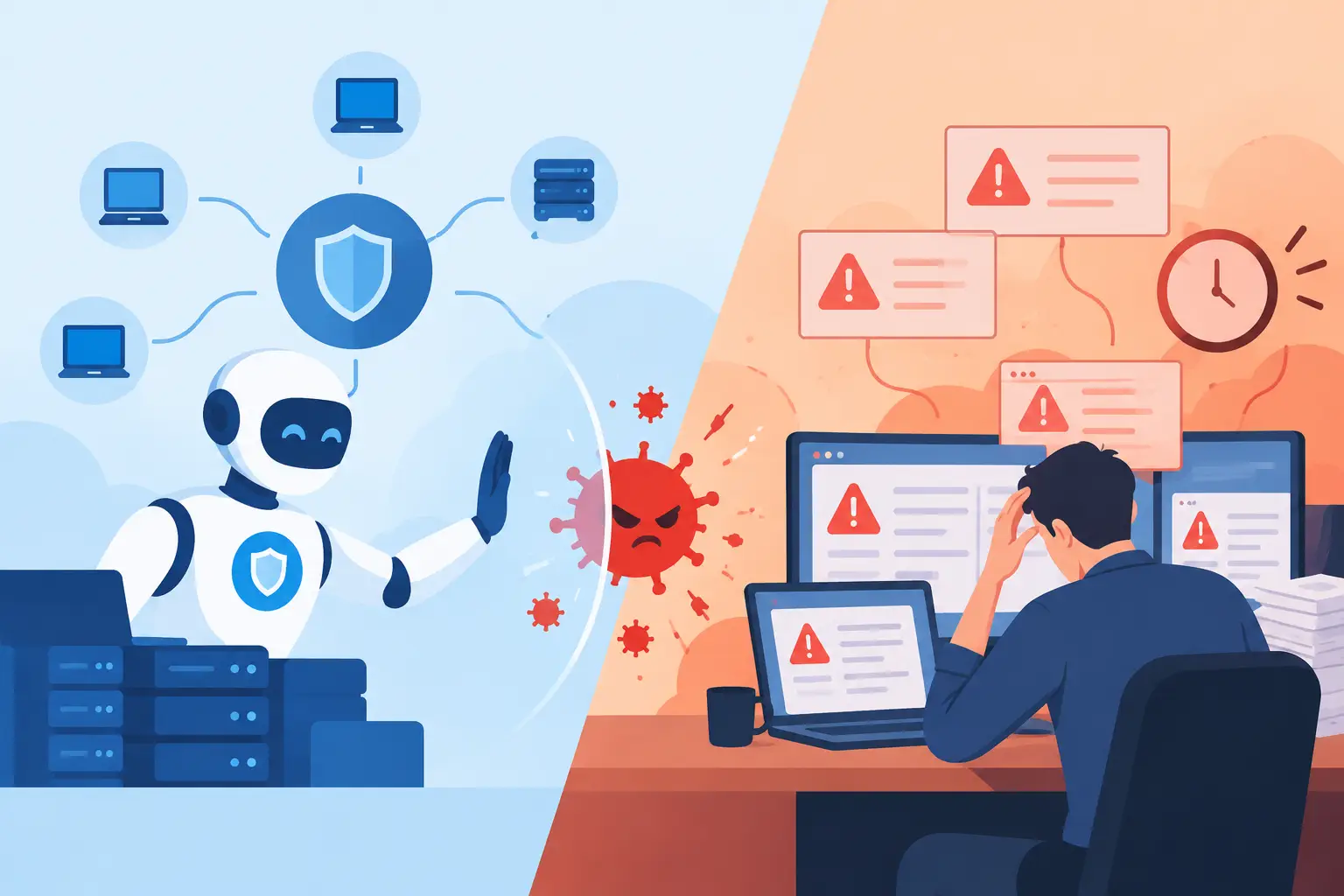
A compromised privileged account does not wait for a change window. It can enumerate systems, alter controls, establish persistence, and move toward production before an analyst has finished correlating alerts. The real question in SOAR versus manual containment is not whether people or automation are more valuable. It is whether the organization can make the right containment decision fast enough to preserve the mission.
For enterprises protecting regulated data, operational technology, high-value accounts, and critical services, containment is the moment that defines an incident. Detection tells you danger is present. Containment determines whether that danger becomes a disruption, a reportable breach, or a business-stopping event.
SOAR versus manual containment: the operational difference
Manual containment relies on analysts, incident responders, and system owners to validate a threat, decide on a response, obtain authority where required, and execute actions across security tools. Those actions may include disabling an account, revoking a session, isolating an endpoint, blocking an IP address, disabling a cloud access key, or restricting a network segment.
That process can be precise. It can also be slow. Every handoff introduces delay, and every separate console creates another opportunity for context to be lost. At 2:00 a.m., during an active ransomware event, an analyst may need to coordinate with identity, network, endpoint, cloud, and operations teams before the attacker reaches the next target.
SOAR changes the operating model. Security orchestration, automation, and response platforms ingest validated signals and run defined playbooks across the tools that enforce controls. A high-confidence alert can trigger an immediate action: isolate a device, revoke tokens, terminate suspicious sessions, deny malicious infrastructure, preserve forensic evidence, and open an incident record with timestamps intact.
The distinction is not merely speed. It is repeatability under pressure. A practiced responder can perform exceptionally well, but no individual can execute ten cross-platform steps simultaneously, every time, without fatigue or interruption. A well-engineered playbook can.
Where manual containment remains necessary
Manual containment has a clear role when the business impact of a wrong action outweighs the risk of a short delay. Taking an industrial control workstation offline, disabling the account of a senior executive during a critical transaction, or severing connectivity to a life-safety environment requires judgment beyond an alert score.
Human responders also remain essential when signals are ambiguous. A sequence that resembles credential theft may be a legitimate emergency-access workflow. An unusual administrative action may be an authorized migration. Analysts supply the operational context that telemetry alone cannot always see.
Manual response is therefore not obsolete. It is the command function. The weakness appears when teams treat every low-level, repeatable containment task as a manual decision. Attackers exploit that delay.
Where SOAR delivers its strongest advantage
SOAR performs best where the response is urgent, reversible, and supported by multiple corroborating signals. A known malicious IP communicating with an endpoint that has launched suspicious processes is a strong candidate for automated blocking and host isolation. A login from an impossible location paired with a high-risk device posture and anomalous privilege use can justify session revocation and step-up authentication.
These actions narrow the attacker’s options before a human responder begins deeper investigation. The playbook does not replace the investigator. It buys the investigator time and preserves the evidence needed to make a better decision.
For mature security organizations, automation also reduces inconsistency. The same detections receive the same initial response whether they occur during business hours, on a holiday, or while the security team is managing a separate incident. That discipline matters when operational continuity is on the line.
Speed without control is not containment
Automated containment can fail if it is built on weak detections, excessive permissions, or generic playbooks copied from another environment. An automated isolation action that shuts down a production dependency may create the outage an attacker failed to cause. That is why the right comparison is not automated versus manual response. It is governed automation versus unmanaged delay.
A containment program needs decision tiers. Low-risk, high-confidence actions should happen automatically. Moderate-risk actions should require analyst approval within a defined response window. High-impact actions should escalate to designated incident commanders and operational owners, supported by clear emergency authority.
This approach makes the trade-off explicit. Blocking a hostile domain may be safe to automate. Disabling a broadly used service account may require a human check. The policy should reflect asset criticality, identity privilege, operational dependencies, and the confidence of the underlying detection.
Zero Trust strengthens this model because it gives containment more precise controls than an all-or-nothing network shutdown. Rather than treating a user or device as fully trusted until an investigation ends, policy can reduce access based on context. A session can be revoked, a privileged elevation window closed, a device quarantined, or a sensitive-data request denied while essential operations continue elsewhere.
Build containment playbooks around mission assets
The most effective SOAR program does not begin with a library of generic alerts. It begins with the assets the enterprise cannot afford to lose: privileged identities, production applications, operational networks, sensitive data stores, remote administration paths, and third-party connections.
For each asset class, leaders should establish four answers before an incident occurs: what behavior triggers concern, what action can occur automatically, who can authorize escalation, and what evidence must be preserved. This is where many response programs break down. They have alerts but no pre-approved authority model, or they have playbooks that do not account for operational reality.
Define containment authority in advance
During an active compromise, responders should not need to search for the owner of a critical application or debate whether they can revoke a compromised administrator’s access. Define incident authority before the event. Identify primary and backup decision-makers, establish emergency contacts, and specify which actions can proceed when a business owner cannot be reached.
This is particularly necessary for enterprises with distributed operations, regulated workloads, and shared responsibility across IT, security, engineering, and business units. Delay caused by uncertainty is still delay.
Correlate before you automate
A single indicator is rarely enough to justify disruptive action. High-quality containment uses correlation across identity, endpoint, network, cloud, and data signals. For example, a risky sign-in becomes more credible when paired with impossible travel, new MFA enrollment, unusual data access, and command activity on a managed endpoint.
Behavior analytics and threat hunting mapped to known adversary techniques improve this confidence. They help distinguish a noisy alert from a pattern that indicates credential misuse, lateral movement, or data staging. The better the signal quality, the more aggressively an organization can automate without causing needless disruption.
Make evidence part of the playbook
Containment without evidence creates a second problem. Security leaders must be able to explain what happened, what actions were taken, when they occurred, and why those actions were authorized. That matters for regulators, boards, customers, insurers, and internal recovery teams.
Each automated or analyst-approved action should produce signed, timestamped records that preserve the detection context, affected assets, approval path, response result, and remaining risk. This converts incident response from a collection of console screenshots into defensible operational evidence.
At Vulcan Rampart, this principle is built into the response model: cross-tool containment actions are orchestrated with audit-grade evidence, so speed does not come at the expense of accountability.
The human role after automation acts
The strongest model gives automation the first move and gives experienced responders command of the campaign. Once immediate controls have limited blast radius, analysts can investigate persistence, scope the compromise, validate business impact, hunt for related activity, and direct recovery.
They also decide when to reverse containment. A device may be isolated automatically, but restoring it to production requires confidence that malicious persistence is removed, credentials are rotated, policy gaps are addressed, and the asset is safe to trust again. Recovery is not simply reconnecting a system. It is re-establishing control.
This division of labor reduces burnout as well as dwell time. Analysts spend less time performing repetitive clicks across disconnected tools and more time on adversary analysis, threat hunting, stakeholder coordination, and difficult decisions. That is where human expertise has the highest value.
Choose the model your risk can support
Organizations with limited tooling or immature detection may need a more human-led model at first. But they should still identify a small set of high-confidence actions that can be automated safely, such as blocking confirmed hostile indicators or revoking sessions tied to verified account compromise.
More mature enterprises can expand automation as they prove detection quality, validate business dependencies, and exercise playbooks. The goal is not maximum automation. The goal is reliable containment at the speed the threat demands.
Measure the program accordingly: time from detection to first containment action, percentage of incidents contained before lateral movement, false-positive impact, time to restore trusted access, and completeness of incident evidence. These measures show whether the security operation can hold the line when controls are tested.
The practical answer to SOAR versus manual containment is not a winner-take-all choice. Let policy-driven automation stop the immediate spread, and keep accountable human leadership in command of the decisions that carry operational consequence. When the perimeter falls, that balance is what keeps the mission moving.