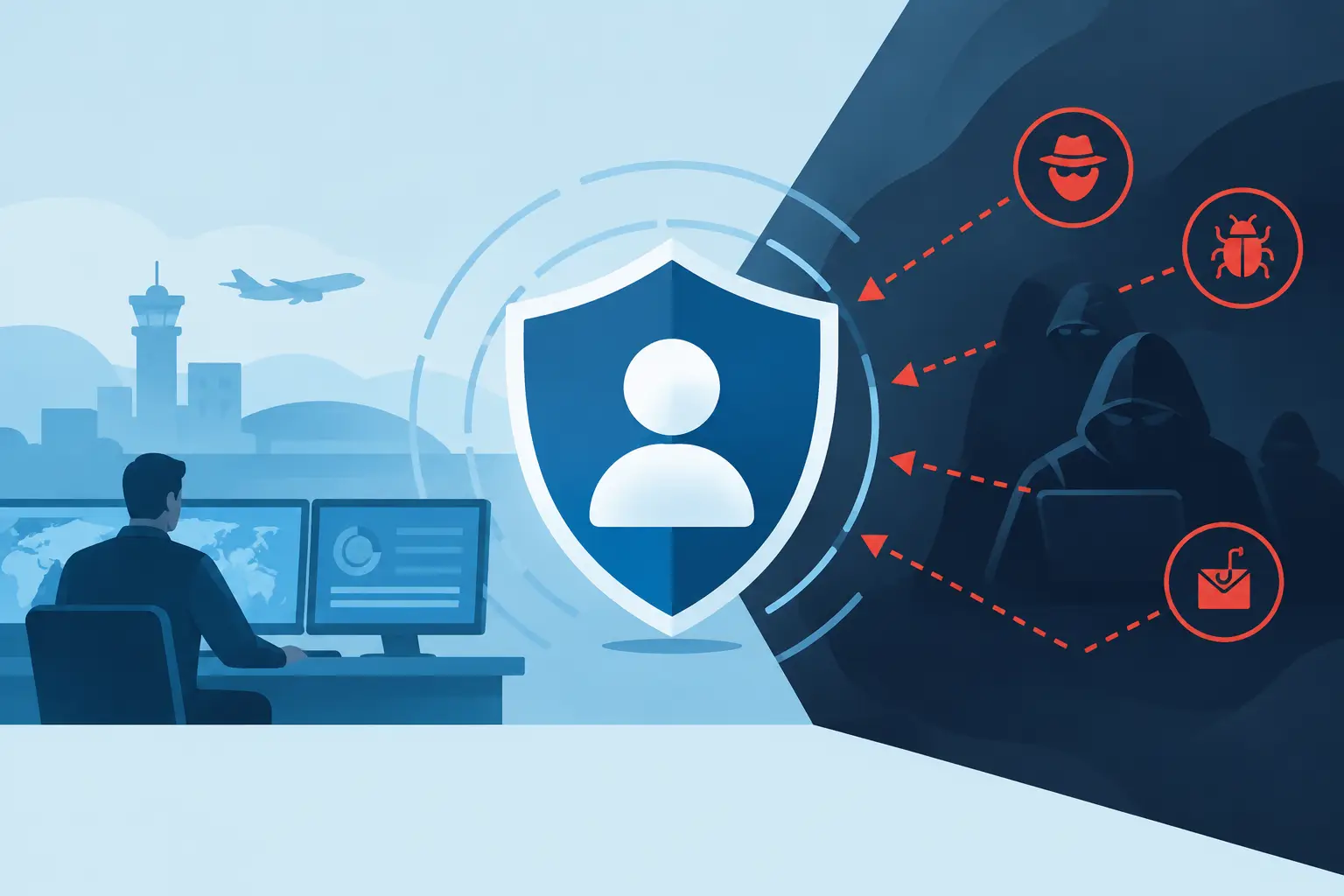
A stolen credential does not look like an attack at first. It looks like a trusted employee signing in, an administrator opening a familiar console, or a service account calling an approved application. That is why identity threats have become a direct threat to mission continuity. When attackers control a valid identity, the perimeter may still appear intact while systems, data, and operational access are already under pressure.
For security leaders, the question is no longer whether multifactor authentication is enabled. The question is whether the organization can recognize when a legitimate identity is being used with illegitimate intent, contain that activity before it spreads, and restore trusted operations with defensible evidence.
Why Identity Threats Carry a Disproportionate Impact
An identity is more than a username and password. It is the collection of permissions, sessions, devices, authentication factors, tokens, roles, and trust relationships that allow a person or workload to act inside the enterprise. Compromise any part of that chain and an attacker may gain a path that traditional perimeter controls were never built to stop.
Attackers acquire identity access through credential phishing, adversary-in-the-middle campaigns, token theft, password reuse, exposed secrets, fraudulent help desk requests, malicious OAuth consent, and compromised third parties. Insider incidents add another dimension. A user may have legitimate access but misuse it deliberately, or retain privileges that no longer match their role.
The first action after compromise is often quiet. An adversary may create a mailbox rule, register a new authentication method, add a device, generate an application secret, or elevate a role during a period of low scrutiny. Those actions can establish persistence without triggering an obvious malware alert. From there, the attacker can move into cloud services, on-premises systems, operational technology environments, financial workflows, or regulated data stores.
The business impact depends on what the identity can reach. A compromised marketing account and a compromised domain administrator are not equivalent events. Neither are a stolen contractor credential and a hijacked account that can approve payments, alter production configurations, or access controlled technical data. Identity defense must therefore be tied to asset criticality, not treated as a generic access-management exercise.
Identity Threats Exploit Trust That Is Rarely Rechecked
Many environments still make a high-stakes decision at login, then extend trust for hours or days. This model assumes that a successful sign-in remains trustworthy even if the device posture changes, a token is stolen, the location becomes anomalous, or the user begins accessing systems outside their normal role.
That assumption gives attackers room to operate. A valid session can bypass password controls. A privileged user who authenticates once may retain broad administrative access long after the business need has passed. A service account with a static secret may persist for years, outside normal human review.
Zero Trust changes the control point. Every request must be evaluated against identity, device health, resource sensitivity, location, behavior, time, and the action being attempted. Access is not granted permanently because a user passed one check. It is earned repeatedly, and it can be revoked when context changes.
This does not mean every user should face unnecessary friction. A well-designed policy engine applies stronger controls where consequences are highest. Reading a low-risk internal document may require far less scrutiny than exporting sensitive data, changing a production firewall rule, or elevating to a privileged role. The goal is not blanket restriction. It is precise control over the paths that can damage the mission.
Privilege Must Be Temporary and Narrow
Standing privilege is an open invitation to identity-based compromise. Administrative authority should be limited by role, resource, and time. Just-in-time elevation creates a controlled window for a defined task, then removes access automatically when that task is complete.
Role-based access control establishes the baseline. Attribute-based access control adds needed context, such as device compliance, project assignment, facility, clearance, risk score, or operational status. Together, they reduce the blast radius of a compromised account without blocking legitimate work.
Service identities need the same discipline. Machine accounts often possess extensive access, yet lack human ownership and meaningful lifecycle reviews. Each should have a named owner, minimal permissions, tightly managed secrets, and monitoring tuned to its expected behavior.
Detect the Behavior, Not Just the Login
A successful authentication event is not proof of safety. Detection must connect signals across identity, endpoint, network, application, and data layers. A sign-in from a familiar location may still be suspicious if the same account immediately accesses a new administrative portal, downloads unusual volumes of data, and initiates remote access to a production system.
User and entity behavior analytics can identify patterns that static rules miss: impossible travel, atypical privilege use, abnormal access times, new device enrollment, unfamiliar API activity, or access sequences that do not match a user’s normal function. Threat hunting mapped to known adversary techniques gives analysts a structured way to test whether those signals form an intrusion path.
Four events deserve immediate investigation when they occur around sensitive accounts:
- A new authentication method, device, or OAuth application is registered without a verified business reason.
- A privileged role is added, modified, or activated outside an approved elevation workflow.
- An account begins accessing systems, datasets, or management interfaces outside its established pattern.
- A session survives a password reset, or tokens continue operating after the associated device is marked risky.
Detection quality depends on context. A security operations center needs visibility into what the account can access, whether the endpoint is managed, whether the activity overlaps with a change window, and whether the user has a legitimate operational reason for the action. Alerts without that context create noise. Context turns telemetry into a containment decision.
Containment Must Outrun the Attacker
When identity compromise is confirmed or strongly suspected, waiting for a manual chain of approvals can turn a single account into an enterprise incident. The first priority is to sever the attacker’s path while preserving the evidence needed to understand what occurred.
Effective containment may include revoking active sessions and refresh tokens, disabling risky authentication factors, blocking hostile IP addresses, isolating the associated endpoint, removing newly created privileges, and suspending suspicious application consent. These actions must be coordinated across identity providers, endpoints, cloud platforms, network controls, and business applications.
Automation is essential, but it must be calibrated. Automatically revoking a high-confidence stolen session is usually appropriate. Automatically disabling an executive or production operator account based on a weak anomaly could create its own operational disruption. Policy should define confidence thresholds, asset criticality, emergency approvals, and fallback procedures before an incident begins.
Vulcan Rampart applies this operating model through continuous monitoring, policy-driven access controls, and SOAR containment playbooks that can revoke compromised sessions and coordinate response actions across tools. Signed, timestamped records ensure that containment is not only fast, but auditable.
Recovery Is an Integrity Exercise
Resetting a password is not recovery if the attacker registered a second factor, created a hidden administrator, copied a token, altered a conditional access policy, or planted persistence in a connected system. Recovery requires proving that trusted access is actually trustworthy again.
That process begins with scope. Investigators need to determine which identities, sessions, devices, applications, and resources were involved; what was accessed or changed; and whether the attacker moved laterally. Account restoration should include factor validation, token invalidation, privilege review, service-account rotation, and inspection of federation settings, application registrations, and delegated permissions.
For regulated enterprises and critical operations, evidence matters as much as speed. Leadership may need to explain what was contained, when access was restored, which records were affected, and why the response was sufficient. A complete audit trail supports incident decisions, customer communication, insurance requirements, and regulatory obligations without slowing the operational recovery itself.
Build Identity Defense Around the Mission
The strongest identity program starts with the systems the organization cannot afford to lose. Map privileged accounts, production platforms, sensitive repositories, operational technology interfaces, remote access paths, SaaS administrators, and service identities to the business processes they support. Then apply the highest assurance to the identities that can disrupt those processes.
Authentication should resist modern credential theft. Hardware-backed WebAuthn and FIDO2 methods provide stronger protection than factors that can be intercepted or socially engineered. Post-quantum hardened authentication, secure credential storage, and carefully governed recovery processes reinforce that protection. SMS-based factors may still have a place as a recovery option in some environments, but they should not carry the same trust level as phishing-resistant methods for high-value access.
The operating principle is direct: default deny, minimum privilege, continuous verification, and rapid containment. It requires investment in visibility, policy design, and response readiness. It also requires executives to treat identity as a mission control plane, not a back-office IT function.
The next identity incident will likely arrive under the appearance of normal access. Prepare for the moment trust changes shape: know which accounts matter most, decide in advance what can be contained automatically, and make sure your team can restore control before the attacker turns one valid sign-in into an operational failure.