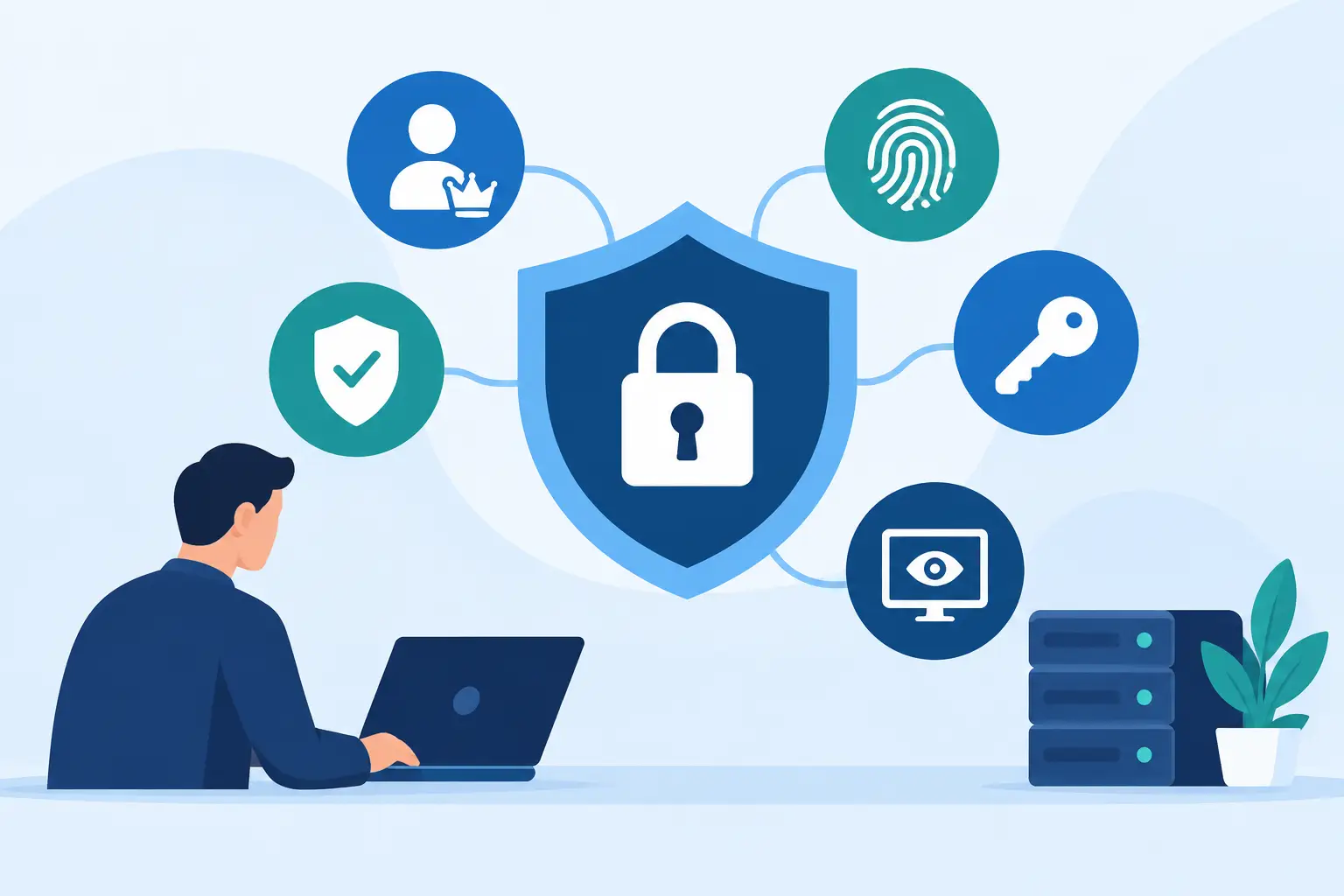
A compromised administrator account is not a routine access issue. It is an attacker operating with the authority to change defenses, erase evidence, move through production systems, and disrupt the mission. The top privileged account safeguards are built for that reality: assume credentials can be stolen, then ensure stolen credentials alone are not enough to win.
For security and operations leaders, the objective is not simply to restrict administrators. It is to preserve the speed required to run the business while making every high-consequence action attributable, narrowly authorized, continuously verified, and recoverable. The strongest programs reduce both the likelihood of compromise and the blast radius when compromise occurs.
Top Privileged Account Safeguards Start With Fewer Standing Privileges
Every permanently privileged account is a standing invitation to misuse, whether the source is an external attacker, a negligent administrator, an over-permissioned vendor, or a trusted insider acting with harmful intent. The first control is not a tool. It is an inventory that answers a hard question: who can administer what, from where, and for what business reason?
That inventory must include traditional domain and cloud administrators, but it cannot stop there. Service accounts, API keys, emergency accounts, CI/CD pipelines, database owners, SaaS superusers, industrial control engineering workstations, and managed-service-provider access often hold equivalent power. Organizations regularly protect the accounts labeled "admin" while overlooking the identities that can deploy code, change routing, disable logging, or extract sensitive data.
Remove dormant accounts. Eliminate shared credentials wherever possible. Separate daily-use identities from privileged identities. A systems engineer should not read email, browse the web, and administer a production environment from the same account. That separation makes phishing, malware, and token theft materially less valuable to an attacker.
Make Privilege Temporary, Specific, and Approved
Just-in-time elevation is one of the most effective ways to shrink the opportunity window. Rather than assigning broad administrative rights indefinitely, grant the required role for a defined task and a limited period. When the work ends, access expires automatically.
This approach should be precise. A request to restart a production service does not inherently justify domain administration. A database maintenance task does not necessarily require access to every production database. Role-based access control establishes baseline job permissions; attribute-based access control adds context such as device health, location, time, ticket approval, data classification, and operational status.
The trade-off is real. Poorly designed approval flows can slow incident response and push engineers toward workarounds. The answer is not to restore permanent privilege. It is to define preapproved emergency paths, automate low-risk elevation, and require stronger verification as requested authority and business impact rise.
Treat Break-Glass Access as a Controlled Emergency System
Break-glass accounts exist because systems fail, identity providers become unavailable, and high-impact incidents do not wait for a normal workflow. They are necessary. They are also among the most dangerous accounts in the enterprise.
A viable emergency account should be isolated, tightly monitored, protected by independent strong authentication, and tested on a scheduled basis. Its use should trigger immediate alerts, capture session evidence, and prompt a post-event review. Credentials must be rotated after every use and held under documented dual-control procedures when practical.
Do not confuse "available in an emergency" with "easy to use whenever access is inconvenient." If break-glass access becomes routine, it is no longer an emergency control. It is unmanaged standing privilege wearing a better name.
Verify Every Privileged Session, Not Just the Login
A password, even a complex one, is no longer sufficient proof for privileged access. Attackers steal credentials through phishing, infostealers, session-cookie theft, help desk manipulation, and compromised third parties. Privileged authentication must require phishing-resistant factors, preferably WebAuthn or FIDO2 hardware keys, backed by strong credential lifecycle controls.
Password storage also matters. Modern hashing such as Argon2id raises the cost of credential cracking if a store is exposed. Post-quantum cryptography preparedness should be part of long-term identity architecture, particularly for organizations protecting data and systems with long risk horizons. But no cryptographic upgrade substitutes for disciplined authorization. The account that never receives unnecessary privilege is the account an attacker cannot elevate through a stolen factor.
Verification must continue after authentication. A trusted user on a managed endpoint may become untrusted when device posture changes, a new network appears, a risky command is issued, or behavior diverges sharply from established patterns. Zero Trust requires the policy engine to evaluate identity, device, context, and intent throughout the session.
That may mean step-up authentication before changing a firewall rule, blocking access from an unmanaged device, or terminating a session when a user attempts to export sensitive data outside their approved scope. The goal is not surveillance for its own sake. It is stopping high-impact actions before they become an incident.
Monitor Privilege for Behavior, Not Only Events
Logs that merely record successful and failed logins are not enough. Privileged misuse is often valid access used in an invalid way. An administrator may authenticate correctly, then enumerate accounts, alter group memberships, disable security tooling, establish persistence, or stage data for removal.
Effective monitoring connects identity activity with endpoint, network, cloud, and data-layer signals. User and entity behavior analytics can identify patterns that conventional rules miss: an engineer accessing unfamiliar systems at an unusual hour, a service account issuing interactive commands, or a privileged session touching an abnormal volume of sensitive files.
Detection coverage should align to the attacker behaviors most likely to threaten your environment. MITRE ATT&CK mapping helps teams test whether they can identify credential dumping, account manipulation, remote service abuse, defense evasion, and lateral movement. The value is not the framework label. The value is knowing that a hostile privileged session will be seen before it reaches its objective.
Record Actions That Must Stand Up to Scrutiny
Privileged activity needs an audit trail that supports operations, investigations, and regulatory review. Capture who requested elevation, who approved it, what policy decision allowed it, what actions occurred, and how the session ended. Where appropriate, retain command logs and session recordings with controls that protect the evidence itself from alteration.
Signed, timestamped evidence is especially valuable after a material incident. It allows leadership to distinguish confirmed facts from assumptions, show regulators what controls operated, and identify exactly where a process failed. Auditability is not paperwork after the fact. It is a control that strengthens accountability before the event.
Contain Misuse at Machine Speed
The difference between detection and containment is where many privileged-access programs fail. A high-confidence alert that waits in a queue while an attacker expands control is not sufficient for mission-critical environments.
Define containment playbooks in advance. When evidence shows a compromised privileged session, the response may need to revoke active tokens, disable or quarantine the account, isolate the endpoint, block hostile infrastructure, rotate exposed secrets, and restrict affected administrative groups. The correct action depends on system criticality and confidence level. Automatically disabling a production automation account on weak evidence can create an outage; allowing clear malicious behavior to continue can create a far worse one.
This is why containment decisions should be policy-driven and tested. Automate decisive action for confirmed high-risk conditions. Require human validation for ambiguous events that could disrupt patient care, manufacturing, public services, or other essential operations. A SOAR capability can orchestrate both paths, preserving a signed record of every response while reducing the delay between signal and action.
Vulcan Rampart applies this posture across identity, endpoint, network, and data controls: detect in seconds, contain in minutes, and preserve the evidence needed to recover with confidence.
Test Recovery Before You Need It
Privileged-account security is incomplete without recovery. If an attacker controls the identity plane, can the organization restore trusted administration without relying on the compromised environment? Can it rotate secrets at scale, rebuild access policies, validate system integrity, and return critical operations to service?
Run exercises that begin with plausible failures: a cloud tenant administrator is compromised, a vendor account is abused, a service credential is exposed in source code, or an insider changes access policies before departing. Test the technical response and the decision chain. Who can authorize containment? Who contacts the vendor? Which systems must remain available? What evidence must be preserved?
The final safeguard is leadership discipline. Privileged access should be reviewed as a living risk decision, not an annual certification exercise. When every elevation is earned, observed, and reversible, the enterprise is far harder to turn against itself.